UDSN Newsletter for September-October 2026
Public programming
2026 UDSN Discussion Series
Inaugural Panel of the 2026 Ukraine Decolonial Studies Network Discussion Series
Watch OnlineUDSN Newsletter for September-October 2026
Upcoming Events
Ukraine’s Archival Landscape: Remote Access and Research Opportunities
Online webinar series | August 28 – November 20, 2026 | Every other Friday
This seven-part webinar series introduces researchers to Ukraine’s central state archives and opportunities for remote access. It opens with a keynote by Prof. Dr Maryna Paliienko, followed by sessions led by directors of six central state archives presenting their holdings and possibilities for remote consultation. Each webinar includes a Q&A and simultaneous Ukrainian–English interpretation. Participation is free. Details and registration
Russia’s War against Ukraine and Its Consequences for Switzerland. University of Basel, Kollegienhaus, Aula | August 20, 2026 | 17:30–19:30
This public panel discussion examines how Russia’s war against Ukraine is affecting Switzerland, from debates over neutrality and defence policy to the arrival and integration of Ukrainian refugees and Switzerland’s role in trade involving Russian commodities. The discussion will also consider how the war is reshaping Swiss society and its self-perception. Speakers: Anna Jikhareva, Marco Jorio, Olha Shvets, Nazar Zatorskyy. More information.
The Ukrainian Book Challenge. Harvard Ukrainian Research Institute (HURI) / Ukrainian National Women’s League of America (UNWLA)
The Ukrainian Book Challenge is an annual initiative encouraging readers to support Ukrainian voices in English by purchasing at least one book about Ukraine or by a Ukrainian author each year. Launched by HURI and UNWLA, with support from the HUCUS Foundation, the initiative aims to strengthen the visibility of Ukrainian literature, history, and culture while supporting the translators, editors, and publishers who bring these works to global audiences. Books can be read, gifted, donated to libraries, or simply added to personal collections. More information
Book Talk: Queen Saturday. Harriman Institute, Columbia University | September 23, 2026 | 12:00 PM | Online
The Ukrainian Studies Program at the Harriman Institute hosts a presentation of Queen Saturday by Borys Khersonsky. The discussion will feature the author together with translators Svetlana Lavochkina and Oksana Rosenblum, and publisher Grace Mahoney, and will be moderated by Mark Andryczyk. More information.
Ukrainian Art Music as Cultural Resilience: Recovering Voices, Reclaiming Identity. Harriman Institute, Columbia University | October 15, 2026 | 4:15 PM | Hybrid
Composer, pianist, and educator Oleh Bezborodko will explore how Russia’s full-scale invasion has reshaped Ukrainian musicians’ engagement with their cultural heritage. Drawing on rediscovered, performed, and newly created works, the lecture examines Ukrainian art music as a source of resilience, historical continuity, and renewed cultural identity. More information.
Publications, Media, Resources
New Practical Guide: Documenting Cultural Heritage Destruction to Overcome the Consequences of War. Ukrainian Heritage Monitoring Lab (HeMo) / NGO Tustan, 2025
This practical guide draws on three years of Ukrainian experience documenting cultural heritage destruction during Russia’s war against Ukraine. It presents approaches to damage assessment, field documentation, data management, expedition planning, and forensic heritage, combining Ukrainian experience with international practices. Intended for researchers, heritage professionals, and practitioners, the guide also addresses how systematic documentation can contribute to preservation, recovery, and accountability. Read
Digital Resource: Virtual Library of Ukrainian Women’s History. Ukrainian Association for Research in Women’s History
The Virtual Library of Ukrainian Women’s History provides open access to more than 650 publications on women’s history in Ukraine, with new materials added regularly. Recent additions include research on women’s education and philanthropy in Odesa, women’s roles in Galician families in the first half of the twentieth century, and a growing selection of English-language works. Readers are also invited to suggest publications for inclusion in the collection. Visit the Virtual Library | Suggest a publication
New edited volume: Narrating the Holodomor: Between History and Memory. Edited by Oksana Vynnyk. University of Toronto Press, 2026.
This collection examines the social and cultural history of the Holodomor through both top-down and bottom-up perspectives, with particular attention to lived experience, agency, memory, and trauma. By recovering individual voices and tracing the effects of decades of silencing, the volume explores how personal experiences of the 1932–33 famine shaped later historiography and memory discourse. More information
New publication: Kateryna Chernii. Valeriy Lobanovskyi: Ukrainian Football between Empire and Nationhood. Common Ground Research Networks, 2026.
This book examines Valeriy Lobanovskyi’s career as a lens for viewing Soviet legacies, Ukrainian nationhood, and the transition from the USSR to independent Ukraine, highlighting his significance far beyond football. More information.
New publication: Serhii Plokhy. David and Goliath: Commentaries on the Russo-Ukrainian War. Harvard University Press, 2026.
This volume brings together Serhii Plokhy’s essays, commentaries, and interviews written before and during the first two years of Russia’s full-scale invasion of Ukraine, offering historical perspective on the largest war in Europe since World War II as it unfolded. More information.
New publication: Alexander Kulik. Jews in Old Rus’: A Documentary History. Harvard University Press, 2026.
This volume presents primary-source documents on early Slavic-Jewish relations, offering the original texts alongside English translations and providing a documentary foundation for the study of Jewish history in Old Rus’. More information.
New publication: Volodymyr Rafeyenko. Signals of Being, Or Verbum Caro Factum Est. Translated by Mark Andryczyk. Harvard University Press, 2026.
Combining experimental dramatic form with quotations from Ukrainian classical and contemporary literature, as well as Shakespeare, Rilke, and others, Signals of Being offers a compelling literary interpretation of Ukraine at war. More information.
Wenn Lachen zur Waffe wird: Humor als Widerstand in der Ukraine (When Laughter Becomes a Weapon: Humor as Resistance in Ukraine). Interview with Kateryna Yeremieieva | Plattform Wiederaufbau Ukraine
The interview explores Ukrainian wartime humour as a form of cultural resistance, examining the social and psychological functions of memes, jokes, and dark humour, as well as their ethical limits and potential role in resilience and postwar reconstruction. Read.
Kimberly Marten on Russia’s War against Ukraine. BBC | August 13, 2026
Kimberly Marten discusses Russia’s ongoing war against Ukraine, Russia’s defence relations with North Korea, and the release of Robert Gilman in a recent BBC appearance. Watch.
Matthew Murray on Why Sanctions Against Russia Aren’t Enough to Achieve Sustainable Peace in Ukraine. Just Security | May 21, 2026
Matthew Murray argues that sustainable peace in Ukraine will require more than sanctions, including the de-oligarchization and dismantling of Russia’s wartime economy and the creation of a new European economic security architecture. He calls for sanctions to be integrated into a broader strategy of economic statecraft. Read.
Conference calls
Ukraine Days in Brandenburg
7–9 October 2026, Wildau and Berlin. Registration deadline: 31 August 2026.
A multi-day programme bringing together universities, researchers, institutions, and other participants engaged in German-Ukrainian academic cooperation. Participation is free. More information
The Duty of the Good Life: Ukrainian Perspectives on Living on the Edge
Ukrainian Studies Hub, University of Notre Dame, USA | March 18–20, 2027
Proposal deadline: September 1, 2026
The Nanovic Institute for European Studies at the University of Notre Dame, in partnership with the Ukrainian Catholic University, invites proposals for its 2027 Ukrainian Studies Conference. The interdisciplinary event explores how Ukraine’s experience of war and existential threat reshapes ideas of resilience, dignity, solidarity, and the “Good Life.” Contributions are welcome across the humanities, law, health, science and technology, security, economics, philosophy, and related fields, with particular attention to how Ukrainian society can protect human dignity and build a resilient future amid ongoing destruction. More information
Spaces of the Holocaust: Occupation Regimes, Borders, and Local Experiences in Ukraine. Center for Urban History, Lviv, Ukraine | December 10–11, 2026
Proposal deadline: September 15, 2026
This conference invites scholars, museum professionals, archivists, early-career researchers, and advanced PhD candidates to explore the Holocaust in Ukraine from transregional and comparative perspectives. It examines how various occupation regimes influenced violence, mobility, survival, memory, and daily life across territories under German, Romanian, and Hungarian administration. Key topics include microhistory, marginalized groups, testimony, digital humanities, collaboration, and methodological challenges. The conference will be conducted in Ukrainian, with some English panels and interpretation available. Travel and accommodation will be provided for participants lacking institutional funding. More information
SOYUZ Symposium. Ethnography Meets Geopolitics: Postsocialist Cultural Studies in an Age of War, Reconstruction, and the Erosion of the Liberal World Order
Harriman Institute, Columbia University, New York City | February 26–27, 2027
Proposal deadline: September 18, 2026
The revived SOYUZ Symposium invites scholars to explore postsocialist cultural studies in light of Russia’s invasion of Ukraine and global political shifts. The conference focuses on how geopolitical changes manifest in everyday life and the role of ethnography in understanding war, reconstruction, and political change. Key topics include social repair in Ukraine, displacement, geopolitical solidarity, justice, and evolving ethnographic methods during crises. Scholars from the humanities and social sciences are welcome, particularly graduate students and early-career researchers. More information
Women in Surrealism: Archives, Networks and Political Engagements (1920–1980)
German Center for Art History (DFK Paris), Paris | November 26–27, 2026
Proposal deadline: September 20, 2026
This conference explores women’s roles and networks within Surrealism between 1920 and 1980, with particular attention to archival invisibility and political engagement. It invites contributions examining feminist, anti-fascist, and anti-colonial perspectives, as well as the ways women artists participated in and shaped transnational Surrealist networks. Proposals may be submitted in English or French. More information
BASEES 2027 Annual Conference — Call for Papers, Panels & Roundtables
Robinson College, University of Cambridge, UK | April 9–11, 2027
Proposal deadline: October 5, 2026
The BASEES 2027 Annual Conference invites proposals for papers, panels, and roundtables across Ukrainian Studies, history, politics, film and media, literature and culture, and related disciplines. Contributions that help decentre and decolonise the study of Eastern Europe and Eurasia are particularly encouraged. Remote paper presentations are possible, although fully remote panels are not accepted. More information
Publication calls
Journal of Digital Media & Policy — “Media Reform in Post-Conflict Societies: AI Governance, Digital Resilience, and Democratic Transformation” Abstract deadline: September 11, 2026
Call for contributions to a special issue examining media reform, digital resilience, AI governance, and democratic transformation in post-conflict societies. The topic may be particularly relevant to research on Ukraine, war, reconstruction, and information infrastructures. More information
Calls for Editor
International Migration. Deadline: September 6, 2026.
The International Organization for Migration (IOM) is seeking a new editorial team of 2–4 editors for International Migration, its peer-reviewed journal devoted to migration and human mobility. More information
IOM Research Partners Panel 2026. Deadline: September 13, 2026
Individual researchers and research organizations are invited to apply to join IOM’s global research network, supporting collaboration and knowledge exchange on migration and mobility. More information
Jobs
Outreach and Communications Officer. Research Centre Ukraine, Max Weber Foundation, Lviv. Deadline: September 1, 2026
Part-time (50%) position supporting public engagement, digital communications, newsletters, podcasts, exhibitions, and dissemination of the Centre’s research. Excellent Ukrainian and English are required. More information
Academic Coordinator. Research Centre Ukraine, Max Weber Foundation, Lviv. Deadline: September 5, 2026
Full-time position within Rethinking Europe: Ukrainian History as Entangled History. The role combines scholarly coordination, event and publication management, and development of the Centre’s research programme. A PhD in history or a related discipline and excellent Ukrainian and English are required. More information
Three Postdoctoral Positions. Research Centre Ukraine, Max Weber Foundation, Lviv. Deadline: September 7, 2026.
The Research Centre Ukraine of the Max Weber Foundation invites applications for three full-time postdoctoral positions within the project Rethinking Europe: Ukrainian History as Entangled History. Research areas include the Black Sea region; Kyiv–Rome–Istanbul and centre/periphery relations; and minorities, ghettos, and exclusion. Positions run through April 2030. More information
Scientific Collaborator / Academic Researcher – DFG Project TransCaMiUA. Protestant University of Applied Sciences (Evangelische Hochschule), Ludwigsburg, Germany. Application deadline: September 8, 2026
The university is recruiting two part-time (65%) researchers for three years for the DFG-funded project Transformations of Social and Family Relationships and Care Constellations of Young People in the Context of War-Related Migration from Ukraine (TransCaMiUA). The project uses participatory qualitative longitudinal research to examine migration, social support, and transitions among young people displaced from Ukraine. Applicants should hold a relevant Master’s degree, have experience in qualitative research and migration/refugee studies, and possess excellent Ukrainian and/or Russian, very good German, and academic English. The positions offer the opportunity to pursue a doctorate. More information
Grants
Norwegian Scholarship Programme for Ukrainian Writers. Deadline: 31 August 2026.
Twenty-three scholarships of €5,000 each for Ukrainian authors developing new works of fiction, nonfiction, poetry, children’s literature, or young-adult literature. The programme supports projects reflecting on the war since 2014, Ukrainian culture in European and global contexts, and cultural diversity. More information
ZMINA: Resilience — Support for International Showcasing of Co-Creation Projects. First-round deadline: 14 September 2026.
Funding for cultural organizations in Ukraine and other Creative Europe countries. Projects must involve at least one Ukrainian organization and one organization from another Creative Europe country. Grants of up to €50,000 are available, covering up to 90% of project costs. More information
Eidolon Grant 2026 — Everyday Photography. Deadline: 30 September 2026.
Funding for projects addressing contemporary everyday photographic cultures or historical vernacular photography. A total of €25,000 will be distributed among selected projects. More information
Gerald D. Feldman Travel Grants — Max Weber Foundation. Deadline: 4 October 2026.
Travel grants for humanities and social-science researchers in the qualification phase conducting transnational or comparative research in two or three countries. Ukraine is among the eligible research destinations. Funding includes travel expenses and daily allowances. More information
Fellowships and courses
Philipp Schwartz Initiative for Researchers at Risk. Alexander von Humboldt Foundation, Germany. Deadline: August 21, 2026
The Philipp Schwartz Initiative supports researchers at significant and ongoing personal risk by enabling them to continue their academic work at universities and research institutions in Germany. Fellowships are available across disciplines for up to 24 months, with a possible extension of up to 12 months. Researchers cannot apply directly; applications must be submitted by eligible German host institutions. Candidates must hold a doctorate or equivalent degree and demonstrate both academic qualifications and at-risk status. For applicants from Ukraine, a signed self-report describing their risk situation is sufficient. Funding can begin from January 1, 2027, and up to 35 fellowships are expected to be awarded in the current call. More information
Call for Applications: Advancing Sustainable Development in Ukraine
Harvard T.H. Chan School of Public Health | Two-semester programme | Free of charge. Application deadline: August 30, 2026
This project-based programme supports Ukrainian professionals engaged in recovery and reconstruction. Participants work with ministries, municipalities, private-sector partners, and international experts to develop real-world projects aligned with EU and international investment standards. The programme focuses on sustainable reconstruction, public health, climate and energy solutions, innovation, entrepreneurship, and financing, combining expert instruction with collaborative project development. Applications are reviewed on a rolling basis, with approximately 90–100 participants expected. More information
Invisible University for Ukraine (IUFU) — Fall 2026. Central European University / Global Invisible University | Hybrid. Deadline: September 9, 2026
The Invisible University for Ukraine (IUFU), now part of the expanded Global Invisible University (GIU), invites applications for its Fall 2026 semester. The free programme offers interdisciplinary online courses on Ukraine in European and global contexts, including Soviet history, borders and spatial imaginaries, Ukrainian literature, care, justice, and social science research methods. Eligible BA, MA, and PhD students connected to Ukrainian universities can also apply for competitive research scholarships of up to €800 per semester. English is the primary language of instruction. More information and application
ERC Postdoctoral Fellowship: The Soviet Union’s Home Front and the War on Soviet Civilians. Centre d’Histoire, Sciences Po, Paris, France | January 2027 – January 2029. Deadline: September 15, 2026
The ERC Advanced Grant project The Global War on Civilians, 1905–1945, led by Prof. Sheldon Garon, invites applications for a postdoctoral fellowship focusing on the Soviet home front and wartime violence against civilians during the Second World War. The research will address civilian mobilisation, food provision, civil defence, morale, transnational models of wartime organisation, and Nazi Germany’s campaigns against Soviet civilians, including blockades and starvation policies affecting cities such as Kyiv, Kharkiv, and Leningrad. More information
German Historical Institute Warsaw Fellowships. Deadline: 30 September 2026.
Research fellowships supporting projects in German and East Central European history that require research stays in Poland, Lithuania, or the Czech Republic. Fellowships provide approximately €1,300–€1,800 per month, depending on career stage. More information
Möllgaard Fellowship. Leibniz Institute for Educational Media | Georg Eckert Institute (GEI), Germany. Deadline: September 30, 2026 (applications also accepted year-round)
The Möllgaard Fellowship supports researchers from Ukraine and neighbouring Central and Eastern European post-Soviet countries, providing access to GEI’s extensive textbook collections and opportunities for comparative research and academic exchange. The programme is open to early-career and established scholars as well as textbook authors. Applications submitted by September 30 are considered in the regular annual selection cycle; applications outside this period are also possible, subject to accommodation availability. More information.
One-Year Scholarship Programme for Graduates from Central, Eastern and Southeastern Europe. Free State of Bavaria | Academic year 2027–2028. Deadline: December 1, 2026
The Free State of Bavaria offers one-year scholarships to graduates from Ukraine and other Central, Eastern and Southeastern European countries for postgraduate study, doctoral research, or a one-year research stay at a state or state-funded higher education institution in Bavaria. The programme aims to strengthen academic exchange and research cooperation between Bavaria and the region. The scholarship provides €992 per month (€11,904 per year), or €1,152 per month for recipients with at least one child. Funding may generally be extended twice, for a total period of up to three years. Ukrainian citizens are explicitly eligible to apply. More information
Members’ News
Svitlana Biedarieva has become a new member of PEN Ukraine. PEN Ukraine is a cultural and human rights organisation that unites Ukrainian writers, journalists, scholars, translators, publishers, artists, and cultural professionals. It is also one of the national centres of PEN International.
Newsletter archive
April-May 2026
Ukraine Decolonial Studies Network Recommends: Upcoming Events
NEW: 2026 Ukraine Decolonial Studies Network Event Series
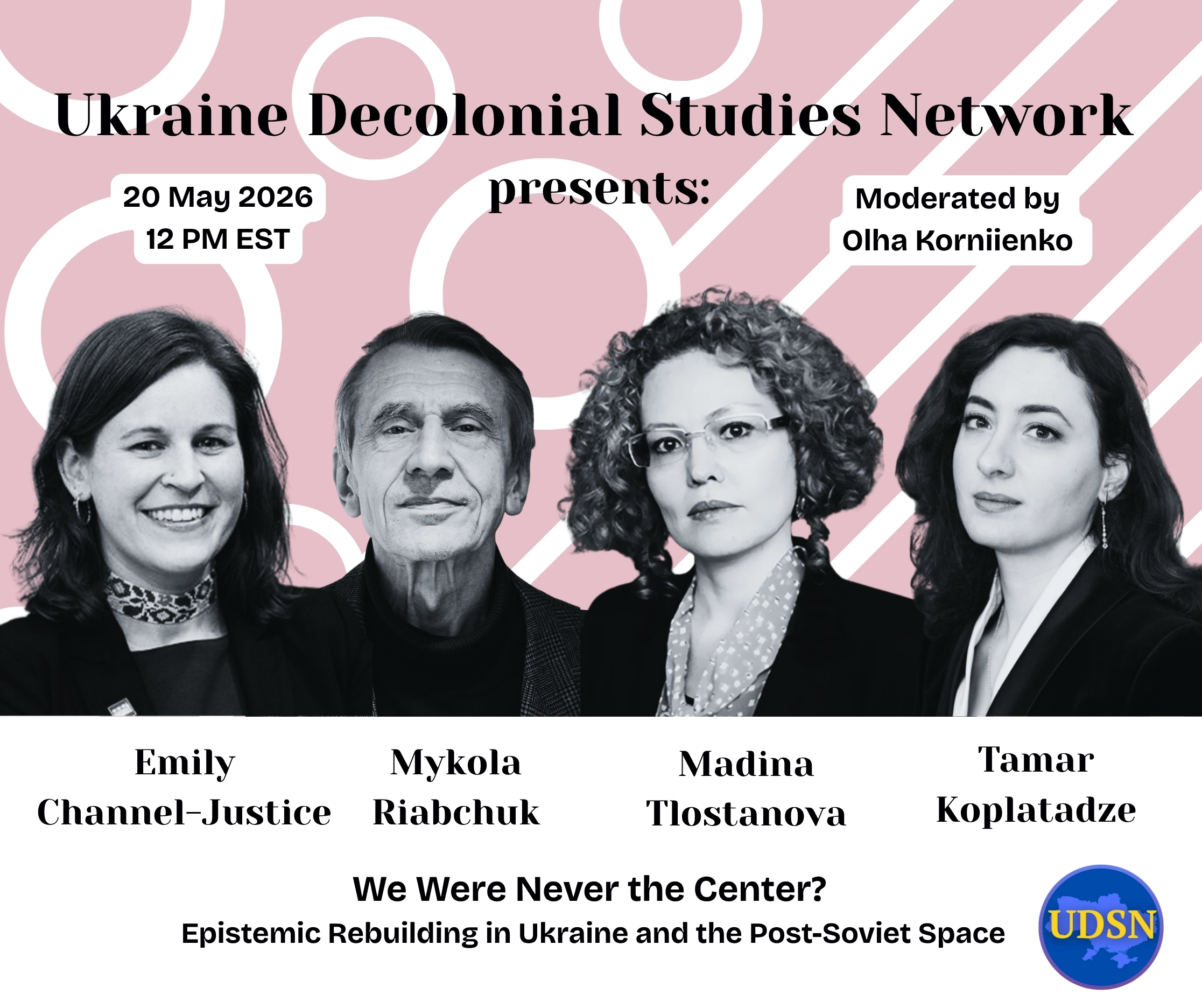
We Were Never the Center?: Epistemic Rebuilding in Ukraine and the Post-Soviet Space
May 20, 2026 | 12:00 EST | Online
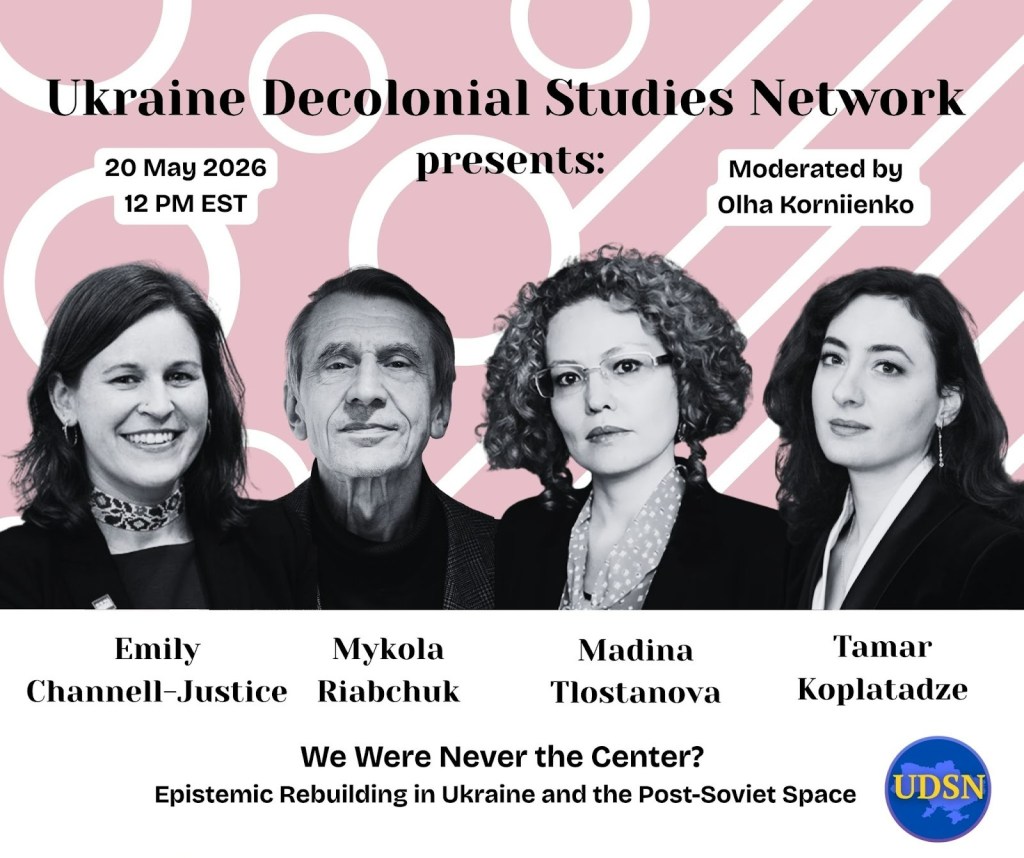
The Ukraine Decolonial Studies Network invites you to a new panel exploring epistemic transformations in Ukraine and the broader post-Soviet region. The discussion examines how knowledge production, agency, and global visibility have long been shaped by Russocentric and colonial center–periphery frameworks, and how these hierarchies are now being challenged and reworked.
Bringing together perspectives from postcolonial and decolonial studies, cultural and political thought, and research on civic agency, the panel addresses processes of epistemic rebuilding, the decentering of Russian-dominated interpretive frameworks, and the emergence of new forms of knowledge through self-organization, public engagement, and collective action in the context of ongoing wars and political ruptures.
Speakers: Madina Tlostanova, Mykola Riabchuk, Tamar Koplatadze, Emily Channell-Justice
Moderator: Olha Korniienko (UDSN Executive Board)
Organized by the Ukraine Decolonial Studies Network (UDSN).
Register via Eventbrite
Ukraine Decolonial Studies Network Recommends: Recent Events
Publications & Media
New publication: Resilienz und Wandel. Historische Perspektiven auf die Ukraine
Published in: Forum RGOW – Religion & Gesellschaft in Ost und West
The new issue Resilienz und Wandel. Historische Perspektiven auf die Ukraine, produced in cooperation with the Ukrainian Research in Switzerland initiative at the University of Basel, explores the resilience of Ukrainian society in the face of Russia’s ongoing war against Ukraine. Despite prolonged attacks and the destruction of infrastructure, Ukrainians continue to resist, reform institutions, and plan reconstruction while articulating visions for the country’s future. The issue places these developments in a broader historical perspective, examining political, economic, and social processes in Ukraine since the late nineteenth century and how they shape contemporary responses to Russian aggression. More information.
The new issue of East/West: Journal of Ukrainian Studies
Published by: Canadian Institute of Ukrainian Studies at the University of Alberta (Vol. 10, No. 2 (2023))
The new issue brings together interdisciplinary research on Ukrainian society, history, language, and public policy. The issue features studies on topics such as social cohesion and diversity in contemporary Ukraine, Soviet-era cultural and literary policies, transnational humanitarian responses to the Holodomor, colonial legacies in Ukrainian higher education, and the development of public policy addressing domestic violence. In addition, it includes research reports, translations of key texts in Ukrainian intellectual history, and reviews of recent scholarship in Ukrainian studies. More information.
New article: Inter-imperial Invisibility and the Logic of Extractivism: Russian Colonialism, Its Environmental Cost, and Federative Futures in Ukraine and Estonia by Epp Annus. Published in Canadian Slavonic Papers (2026).
The article introduces the concept of “inter-imperial invisibility,” showing how imperial powers reduce smaller states to resources and geopolitical interests. Comparing Soviet-era projects such as the Sillamäe uranium plant and the Chornobyl Nuclear Power Plant, it examines the environmental costs of Russian colonialism and reflects on alternative democratic futures. More information.
New article: Colonialism or kolonizatsiia? Why the Difference between Ukraine and Central Asia Matters by Ulrich Hofmeister. Published in Cambridge University Press (2026).
The article examines debates about interpreting Russian–Ukrainian relations through the lens of colonialism. By comparing tsarist rule in Ukrainian territories with governance in the Governorate-General of Turkestan, it argues for a more cautious use of the concept of colonialism in relation to Ukraine. Hofmeister shows that, unlike in Central Asia—where imperial policies institutionalised cultural and religious difference—tsarist rule in Ukraine was framed as incorporation into the Russian nation. The study, therefore, suggests that Russia’s denial of Ukraine’s sovereignty reflects nationalist usurpation rather than a classical colonial model. More information.
Events
Workshop: The Impact of Four Years of Warfare on Ukraine
April 17, 2026 | Harvard University, Cambridge (MA) / Hybrid format
This workshop examines the consequences of Russia’s full-scale war against Ukraine as it enters its fifth year, focusing on transformations already visible across key areas of Ukrainian society and statehood. Bringing together leading scholars and experts, the event explores developments in politics and governance, international positioning, the military and defence sector, the economy, religion and language, and demographic change.
Organized as part of the 2026 Petro Jacyk Symposium in Ukrainian Studies by the Harvard Ukrainian Research Institute, the workshop forms part of a broader series addressing the impact of the war on Ukraine and Russia. The program combines expert presentations with moderated discussions to assess how ongoing warfare is reshaping Ukraine’s trajectory in both domestic and international contexts. More information.
Talk: Intent to Destroy — Russia’s Two-Hundred-Year Quest to Dominate Ukraine
April 21, 2026 | New York University, New York / Hybrid format
This talk by Eugene Finkel (Johns Hopkins SAIS) examines the historical roots of Russia’s war against Ukraine through the lens of imperial ambition and nationalism. Drawing on his recent book, Finkel traces how efforts by the Russian Empire, the Soviet Union, and contemporary Russia to dominate Ukraine have evolved over two centuries, culminating in the current conflict. The lecture highlights how Ukraine’s growing civic cohesion has reshaped its response to invasion, offering new perspectives on resistance, identity, and statehood. Hosted by the Jordan Center for the Advanced Study of Russia, the event will take place in a hybrid format. More information.
Book Talk & Discussion: Ecocide in Ukraine — The Environmental Cost of Russia’s War
April 22, 2026 | Harvard University, Cambridge (MA) / Hybrid format
This event features a discussion with Darya Tsymbalyuk (University of Chicago) on her award-winning book examining the environmental consequences of Russia’s war against Ukraine. The talk addresses the large-scale destruction of ecosystems, biodiversity loss, and long-term environmental damage caused by military actions, including the destruction of the Kakhovka Dam. More information.
Opportunities / Calls
Conference calls
Call for Papers: Recentering the Humanities — Ukraine and the World
Edmonton, Canada | October 28–30, 2026
Submission deadline: April 20, 2026
The Canadian Institute of Ukrainian Studies at the University of Alberta invites graduate students and emerging scholars to apply to present their research at the international symposium “Recentering the Humanities: Ukraine and the World.” The event marks the institute’s 50th anniversary and will examine Ukraine’s place in global scholarly debates, particularly in light of Russia’s full-scale invasion in 2022 and Ukraine’s growing visibility in geopolitical and cultural discussions. A limited number of participants will receive competitive travel grants of up to US $500. More information.
Call for Papers: Reckoning and Remembrance – Germany, Ukraine, and the Second World War after 1945
Munich, Germany | September 2–4, 2026
Submission deadline: May 4, 2026
Scholars are invited to submit proposals for the conference “Reckoning and Remembrance: Germany, Ukraine, and the Second World War after 1945,” organised at the Ludwig Maximilian University of Munich. The event will examine the legacy of German occupation in Ukraine during the Second World War and how German crimes, Ukrainian resistance, and collaboration have been addressed in historiography, law, and public memory since 1945.
The conference particularly welcomes studies on representations of Ukraine and Ukrainian nationalism in post-war Germany, as well as broader discussions of memory politics and historical interpretation in both German states. Travel and accommodation will be covered by the organisers. The conference will take place in a hybrid format. More information.
Call for Papers: Embracing the New, Preserving the Old — Studying Fascism, Communism, and Totalitarianism in the 2020s
Warsaw, Poland | October 14–15, 2026
Submission deadline: May 15, 2026
The Pilecki Institute invites submissions for the 2026 Pilecki Institute Congress, an international conference examining new and traditional approaches to the study of fascism, communism, and totalitarianism. The event will bring together scholars from history, political science, sociology, cultural and media studies, and related fields to discuss how these concepts are being reinterpreted amid digital transformation, geopolitical change, and renewed debates over imperialism and authoritarianism.
The congress encourages interdisciplinary contributions addressing topics such as new methodological approaches to totalitarianism, digital archives and AI in historical research, propaganda and disinformation, and the ongoing relevance of traditional scholarly methods. Both individual papers and panel or roundtable proposals are welcome. More information.
Call for Abstracts: UKRAINETT+ Conference 2026 — State and Society Under Pressure: Internal and External Dynamics
Oslo, Norway | November 11–12, 2026
Submission deadline: May 15, 2026
The annual UKRAINETT+ Conference in Ukraine Studies will take place at Oslo Metropolitan University. The conference invites scholars from the social sciences and humanities to examine how Ukraine’s state and society respond to internal and external pressures in the context of Russia’s ongoing war and a changing international environment.
Proposals are welcome on topics such as Ukraine and the evolving international order, foreign support for Ukraine, democratic governance and resilience, political leadership and elites, social cohesion and identities, war and displacement, economic transformation and reconstruction, civil society mobilisation, media and information warfare, and politics of memory. More information.
Study Programmes
Online Course: Famine as Genocide — The Holodomor in Ukraine
Available on Coursera
The Holodomor Research and Education Consortium at the Canadian Institute of Ukrainian Studies, University of Alberta, has launched a new free online course, “Famine as Genocide in the 20th Century: The Case of the Holodomor.”
The 13-module course offers an in-depth exploration of the Holodomor of 1932–33 within broader historical and global contexts. It examines the famine through perspectives including genocide studies, colonialism and empire, survivor experience, and disinformation, while situating it within Ukrainian and Soviet history.
Drawing on recent research, the course highlights the importance of the Holodomor for understanding not only Ukrainian and Soviet history, but also wider questions of famine, genocide, and memory in the twentieth century and today. More information.
Certificate Programme in Interdisciplinary Ukrainian Studies
Info Session: April 21, 2026 | Online (Zoom)
The Competence Network for Interdisciplinary Ukrainian Studies Frankfurt (Oder) – Berlin (KIU) is launching a Certificate Programme in Interdisciplinary Ukrainian Studies for Master’s students. Offered in cooperation with European University Viadrina and partner institutions, it is the first comprehensive Ukrainian Studies certificate programme at the Master’s level in Germany.
The programme can be completed within one to two semesters alongside Master’s studies and concludes with a certificate issued by European University Viadrina. Teaching involves scholars from Humboldt-Universität zu Berlin and Freie Universität Berlin and includes interdisciplinary courses, Ukrainian language training, and a Ukraine-related internship.
The programme is open to Master’s students at Viadrina and other German universities. Further details and the Zoom link for the April 21, 2026, info session are available on the programme website. More information.
Ukraine Lecture Series: Nationalities, Minorities and Identity — (Re)Configuring Ukraine?
April 13 – July 13, 2026 | European University Viadrina / Hybrid format
The new edition of the Ukraine Lecture Series explores the diversity of Ukraine’s social and cultural landscape and the role of minorities and national communities in shaping Ukrainian identity. Ukraine is home to more than 100 ethnic groups and several indigenous peoples, many of whom have faced displacement, repression, and threats to cultural rights since Russia’s aggression—particularly in occupied territories affecting communities such as the Crimean Tatars. Weekly lectures will examine historical and contemporary perspectives on minorities, diversity, and identity, highlighting how the ongoing war has reshaped Ukrainian society while revealing its resilience. More information.
Jobs
Call for Course Proposals: War, Memory, and Gender in Transnational Perspective
Off University / Memory Studies Association
Deadline: April 13, 2026
Teaching period: October 2026 – February 2027 (online)
Off University and the Memory Studies Association invite proposals for an interdisciplinary online course in memory studies to be taught by scholars at risk during the winter term 2026–27. The course should address the intersections of war, memory, and gender from a transnational perspective and may examine conflicts, traumatic and contested memories, and memory politics through comparative or global approaches.
Selected instructors will teach a 14-week online course on the Off University platform and receive a teaching honorarium of €4,000. Applicants must hold at least a master’s degree, have relevant teaching and research experience, and be politically persecuted and/or displaced and currently in a situation of material need. Applications should include a course outline, CV, and statements on teaching approach and personal circumstances. More information.
PhD Research Fellowship in Ukrainian Studies
University of Bergen, Norway
Deadline: May 3, 2026
Start date: October 2026 (or as agreed) | Fixed-term: 4 years
The Department of Foreign Languages at the University of Bergen invites applications for a PhD Research Fellowship in Ukrainian Studies. The successful candidate will join the research group on East Slavic languages, societies, and cultures and develop a doctoral project related to Ukraine’s language, history, literature, or culture. The position combines doctoral research with teaching and other career-development activities and includes admission to the Faculty of Humanities’ PhD programme. Applicants must hold a master’s degree in Ukrainian studies, Ukrainian language, or another Slavic field including Ukrainian, and demonstrate proficiency in English and Ukrainian. More information.
Grants
I. Lysiak-Rudnytsky Programme in Ukrainian Studies – Project Call 2026
Deadline: April 29, 2026
The Ukrainian Institute announces the first of two project calls in 2026 within the I. Lysiak-Rudnytsky Programme in Ukrainian Studies. The programme aims to support the production of expert knowledge about Ukraine, strengthen global understanding of Ukrainian culture, and promote international academic cooperation.
Applications are open to foreign universities, educational and cultural institutions, think tanks, and independent researchers. Supported project formats include university courses (including online courses and MOOCs), research visits and summer schools on Ukraine, international interdisciplinary conferences, thematic research projects, and translations of academic literature. Priority topics for 2026 include decolonial and post-imperial Ukrainian studies, research on contemporary Ukraine since 1991, studies of war as a socio-cultural and historical phenomenon, interdisciplinary projects integrating Ukrainian and Crimean Tatar studies into global academic networks, and digital research approaches in Ukrainian studies. Grants of up to $15,000 per project are available. More information.
Fellowships
Fedor Stepun Postdoctoral Fellowship 2026
Ruhr University Bochum, Germany
Fellowship duration: 6 months | Earliest start: August 2026
Application deadline: April 15, 2026
The Fedor Stepun Fellowship supports postdoctoral researchers whose academic work has been disrupted by Russia’s war against Ukraine or by political repression in authoritarian contexts. Hosted at Ruhr University Bochum and implemented with the RUB Research School, the programme enables scholars—particularly from Ukraine, Russia, and Belarus—to continue their research in an international academic environment within the University Alliance Ruhr. The fellowship provides €1,800 per month for six months and supports up to eight fellows annually. Fellows conduct their research at one of the partner institutions of the University Alliance Ruhr while developing new projects and preparing future research funding applications. The programme is funded by the Zimin Foundation. More information.
Translating Ukraine Residency Program 2026
Wojnowice Castle, Poland
Residency period: July–September 2026 (3–6 weeks)
Application deadline: May 8, 2026
The Translating Ukraine Residency offers up to 4 Ukrainian-to-English translators the opportunity to work on literary or academic translation projects in a focused, collaborative environment. Hosted at Wojnowice Castle as part of the KEW Archipelagos Fellowship Program, the residency brings together an international community of translators engaged in cross-cultural exchange. The program covers travel, accommodation, and meals, and provides a stipend of $250–$500. It is open to translators at all career stages, with preference given to projects in advanced stages of completion. Applications must include a CV, a project statement, and two letters of recommendation. Selected participants will be notified by June 1, 2026. More information.
Research Scholarships of the German–Ukrainian Historical Commission
German–Ukrainian Historical Commission (Germany)
Research stay: up to 1 month in Germany
Application deadline: May 9, 2026
The German–Ukrainian Historical Commission offers four short-term research scholarships for historians working on German or German–Ukrainian historical topics within MA, PhD, or postdoctoral projects. The fellowship supports archival research and work in specialised libraries and research institutions in Germany. The scholarship provides €1,300 for a one-month stay and a €350 travel grant. The program is funded through the German Academic Exchange Service with support from the German Federal Foreign Office. Applicants must submit a research proposal, CV, copies of diplomas, and a brief research plan. More information.
Research Scholarship 2026.2
Max Weber Network Eastern Europe
Fellowship period: August 1 – December 31, 2026
Application deadline: May 15, 2026
The Max Weber Network Eastern Europe offers one- to three-month research scholarships for postgraduate researchers (PhD candidates and postdocs) in the humanities and social sciences. The program supports archival and library research on historical topics related to the Soviet Union, its predecessor and successor states, and their transnational connections with neighbouring regions and Germany. The scholarship fund research is conducted in post-Soviet countries (excluding Russia and Belarus) and in Finland. Applicants must be affiliated with universities or research institutions in Europe or the South Caucasus, and the fellowship cannot be used for research in the applicant’s country of residence. More information.
March-April 2026
Ukraine Decolonial Studies Network: Upcoming Events
NEW: 2026 Ukraine Decolonial Studies Network Event Series
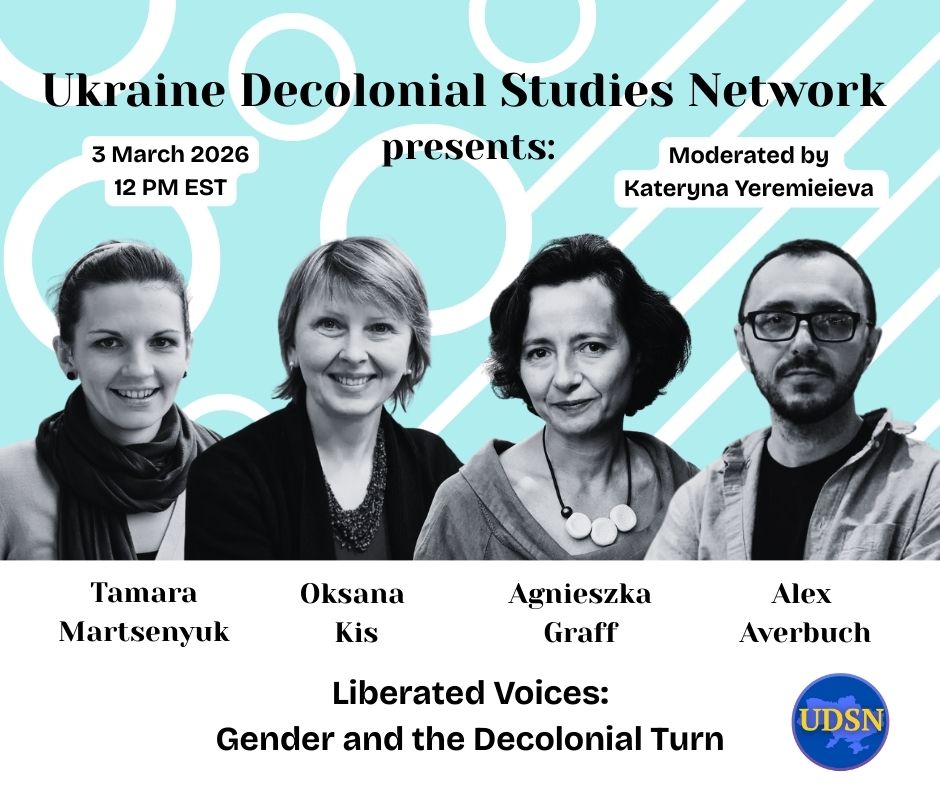
Liberated Voices: Gender and the Decolonial Turn
March 3, 2026 | 12:00 EST | 18:00 CET | 19:00 Ukraine | Online
The Ukraine Decolonial Studies Network invites you to the next panel in its ongoing series dedicated to postcolonial thought and decolonial practice in Ukraine. Liberated Voices: Gender and the Decolonial Turn brings together leading scholars to examine gender and sexuality as critical sites of resistance within decolonial frameworks.
Focusing on Ukraine and Central and Eastern Europe in the context of Russia’s full-scale war and contemporary imperialism, the discussion explores how feminist and queer perspectives challenge colonial legacies, dominant regimes of knowledge, and the long-standing marginalisation of the region within Western feminist theory. Moving between present and past, the panel will address women’s everyday experiences of war, care work, displacement, and political agency, as well as feminist re-readings of Soviet repression and queer cultural practices that unsettle imperial and heteronormative narratives of belonging. The conversation asks how gender and sexuality can function as critical lenses for rethinking empire, war, and knowledge production under conditions of violence and global inequality.
Speakers: Agnieszka Graff, Oksana Kis, Tamara Martsenyuk, Alex Averbukh
Moderator: Kateryna Yeremieieva (UDSN Executive Board)
Organized by Ukraine Decolonial Studies Network (UDSN). Register via Eventbrite.
CFP: Ukraine Decolonial Studies Network at the 58th ASEEES Convention
November 12–15, 2026 | Chicago, IL
Application deadline: February 20, 2026
Ukraine Decolonial Studies Network announces an open call for papers for our panel series to be held at the 58th Annual Association for Slavic, East European, and Eurasian Studies (ASEEES) Convention. We are expecting submissions for our panel series: “Between Empires and States: Decoloniality, Self-Determination, and Agency in Cultures and Societies.” The panel series focuses on decoloniality, self-determination, and agency across cultures and societies, addressing anti-colonial resistance and decolonial processes, solidarity and social cohesion, and epistemic and cultural production. The central questions for the panel will be: How do culture and academia foster emancipation and liberation, facilitating exchange across unequal and diverse social formations amid neocolonial wars, global crises, and the rise of authoritarianism? How do the processes of knowing and producing knowledge inform agency and subjectivity? How can collective action dismantle empires and help build independent states, and under which conditions? The panel brings together scholars from diverse geographical and cultural backgrounds and disciplines to discuss the political and humanitarian roles of knowledge and culture as sites of power in shaping decolonial futures. Submit your proposal to ukraine.decolonial@gmail.com.
Ukraine Decolonial Studies Network Recommends: Recent Events
Solidarity Within and Beyond Ukraine
Cambridge, MA (Harvard University) | January 30–31, 2026
As Russia’s full-scale war against Ukraine approaches its fourth year, this international conference examines the shifting meanings of solidarity in a time of escalating global uncertainty. Bringing together scholars, journalists, activists, diplomats, and cultural figures, the event explores global support for Ukraine, civic engagement within the country, solidarity under occupation, and advocacy in the United States. The program features four thematic panels, an art exhibit, a film screening of 2000 Meters to Andriivka by Mstyslav Chernov, and a keynote lecture by human rights activist and 2025 Václav Havel Human Rights Prize laureate Maksym Butkevych. The conference concludes with a reception and musical performance. More details and the conference program. Watch the recording.
Café Kyiv 2026
23 February 2026 | Colosseum Berlin
Café Kyiv, an initiative of the Konrad Adenauer Foundation, is a major international discussion platform dedicated to Ukraine’s present and future. Bringing together policymakers, scholars, civil society leaders, journalists, artists, and activists, the 2026 edition will address key political, cultural, and security challenges shaped by Russia’s war against Ukraine. The program includes high-level panel discussions on hybrid warfare and comprehensive defence, global solidarity with Ukraine, repression under occupation, democratic resilience, and European partnership in Ukraine’s reconstruction. Special sessions focus on Crimea under occupation, Holocaust education in wartime, civic activism, and human rights.
In addition to academic and policy debates, Café Kyiv features film screenings, artistic performances, exhibitions, and public dialogues, fostering interdisciplinary exchange between experts and broader audiences. The event provides a forum for critical reflection on Ukraine’s role in Europe and the global democratic order. More details | Instagram
Exhibition: “Lens of the Witnesses.” Paintings by Lesia Khomenko
Shevchenko Scientific Society, New York | From February 6, 2026
In a new body of large-scale paintings based on raw footage from the frontline of the Russian-Ukrainian war, acclaimed Ukrainian artist Lesia Khomenko incorporates various records – including drone footage, soldiers’ body cameras, and civilians’ phone records – into seemingly abstract, semi-representational paintings. In her research, the artist adopts the methodology of war-crimes investigators, watching graphic content frame by frame. In turn, Khomenko employs a sharp analytical lens that reads wartime documentation visually rather than forensically. The sheer variety of images allows her to construct a dialogue between historical wars and recent battles by referencing battle paintings produced under the conditions of postwar socialist realism and the contemporary realities of cyberwar.
Publications & Media
Interview: Disentangling Russia’s Colonial Legacy in Ukraine
Conversation with Svitlana Biedarieva | January 20, 2026
In this in-depth interview, Svitlana Biedarieva discusses the concept of ambicoloniality, which she introduced in her book Ambicoloniality and War: The Ukrainian–Russian Case. Speaking with Oleksandr Pankieiev, she outlines how the concept helps explain the specific dynamics of Russian–Ukrainian relations, particularly the interplay of cultural proximity, appropriation, colonial desire, and neocolonial violence. The conversation examines how ambicoloniality sheds light on Russia’s full-scale invasion of Ukraine, the role of propaganda and polymorphous coloniality, and the challenges of disentanglement in conditions of geographic and historical proximity. Biedarieva also reflects on internal hybridity, decolonial processes, epistemic production, and the notion of “decolonial release” as a potential precondition for victory in the current war. Read the full interview.
New publication: Decolonizing Ukraine: How the Indigenous People of Crimea Remade Themselves after Russian Occupation
Author: Greta Lynn Uehling | Bloomsbury Publishing
In this study, anthropologist Greta Lynn Uehling examines the lived experience of Russia’s occupation of Crimea from 2014 onward, focusing on the Indigenous peoples of the peninsula and the broader processes of colonisation, displacement, and resistance. Drawing on extensive fieldwork and more than 90 personal interviews, the book traces how individuals and communities who opposed the occupation rebuilt their lives in government-controlled Ukraine while forging new forms of social cohesion across ethnic and religious lines. By centring Indigenous perspectives, Decolonizing Ukraine argues that understanding Crimea is essential to understanding Ukraine (and Russia’s war against it) today. More information
New publication: The Holodomor in Global Perspective: How the Famine in Ukraine Shaped the World
Edited by Daria Mattingly and John Vsetecka. Foreword by Anne Applebaum | ibidem Press
Between 1932 and 1933, millions of people in Ukraine died of forced starvation. The famine, now known as the Holodomor, became one of the most deplorable acts in the history of the Soviet Union and the wider twentieth century. This collected volume is the first to address the history of the Holodomor from a global perspective. The chapters present perspectives on famine through a multidisciplinary approach that enables us to assess the global implications of mass starvation in Ukraine from 1932 to 1933 and to understand them on a scale that extends beyond Ukraine and the Soviet Union. More information
Opportunities / Calls
Conference calls
Winter School 2026: Ukrainian Migration in Europe and Globally in the 20th and 21st Century
Munich, Germany | March 23–27, 2026
Registration deadline: February 15, 2026
This international Winter School examines Ukrainian migration in the context of Russia’s full-scale invasion and within the broader historical trajectories of the 20th and 21st centuries. Bringing together historical, cultural, legal, and political perspectives, the program explores displacement from occupied territories, migration to European and non-European countries, representations of migration in Ukrainian literature and culture, and the impact of Ukrainian migration on host societies and perceptions of Russia’s war. The Winter School will take place at the Ukrainian Free University in Munich.
The program (in English and German) is aimed at MA and PhD students as well as professionals in social institutions and media. Travel and accommodation costs will be covered; a €50 participation fee applies. To register, please send a short motivation statement (max. one page) and brief personal information to sekretariat.du@ur.de by February 15, 2026. More information.
Borshch of Art Research Fellowships
New York (Virtual) | March – June 2026
Application deadline: February 18, 2026
The Ukrainian-American Arts Research Fellowship is now accepting applications for its newest cycle. This fellowship is for dedicated scholars to delve into artists’ legacies, explore new angles, and contribute to the growing body of academic knowledge in this field. This 12-week intensive research program supports students and early-career scholars in authoring papers on artistic practice and cross-cultural connections. Fellowship support is $500 stipend and a platform for public research presentation upon successful completion. More information.
Call for Research Abstracts: Holodomor Legacy Initiative
Ottawa, Canada | May 2026
Submission deadline: February 23, 2026
Researchers and practitioners are invited to submit abstracts for the Holodomor Legacy Initiative, a major scholarly project supporting new peer-reviewed research on the Holodomor. The initiative forms part of a program funded by Global Affairs Canada to strengthen Ukraine’s National Museum of the Holodomor-Genocide, implemented by Cowater International in partnership with the Canada-Ukraine Foundation. Abstracts (750–1,250 words) are sought for an international symposium to be held in Ottawa in May 2026. Submissions may address historical, demographic, gendered, comparative, cultural, memorial, archival, or legal aspects of the Holodomor and may be submitted in English, French, or Ukrainian. Selected participants will present their work at the symposium and receive support to further develop it through the initiative’s publication series. Submit abstracts and a brief CV via cowater.com/hm. Contact: info-hm@cowater.com.
Call for Speakers: Prairie Conference 2026: Ukrainian Studies in Times of Global Transformations of the Humanities
University of Manitoba, Winnipeg | April 30 – May 2, 2026
Application deadline: February 27, 2026
Undergraduate and graduate students are invited to take part in a roundtable discussion at this year’s Prairie Conference dedicated to the future of Ukrainian Studies and the global transformation of the humanities. The student panel will follow a roundtable format, with 15-minute contributions. Participation is open to students from all universities, programs, and faculties. Travel and participation details are available upon inquiry. To express your interest, please email: petrucho@myumanitoba.ca
Call for Proposals: 58th ASEEES Annual Convention
Chicago, USA | November 12–15, 2026
Proposal deadline: March 1, 2026
The Association for Slavic, East European, and Eurasian Studies (ASEEES) invites proposals for its 58th Annual Convention under the theme “States and Empires.” Submissions are welcome for panels, roundtables, book discussion roundtables, lightning rounds, individual papers (virtual only), film screenings (in-person only), affiliate group meetings, and ancillary events. More information.
Call for applications: Shevchenko Workshop in Ukrainian Studies
October 25 – October 26, 2026 | University of Michigan, Ann Arbor
Application deadline: March 15, 2026
This workshop invites applications from PhD students and other early-career scholars who received their PhDs not earlier than 2023. Scholars from a variety of disciplines—including but not limited to anthropology, the arts, environmental studies, history, economics, law, literary and cultural studies, media studies, political science, and religious studies—are encouraged to apply. Topics include, but are not limited to, civil society, culture, economic development, environment, gender, historical memory, humanitarian aid, international relations, migration, and war. The application form requires submission of an abstract (approximately 300 words) and a biographical statement (maximum 200 words). More details.
Witnessing the War on Ukraine Summer Institute 2026: Beyond Testimony – Silences, Gaps, and Unspoken Memories
Uzhhorod, Ukraine | August 11–14, 2026
Application deadline: April 15, 2026
The fifth Witnessing the War on Ukraine Summer Institute (WWSI) will examine the limits of testimony and the methodological and ethical challenges of working with silence, absence, and the unspoken in war narratives. Since 2022, WWSI has provided an international platform for scholars and practitioners in oral history, memory studies, and related fields responding to Russia’s war against Ukraine. The 2026 Institute will focus on theoretical and methodological debates in oral history and memory studies, with lectures, panels, workshops, and participant project discussions. The keynote lecture will be delivered by Alistair Thomson. The working language is English. The Institute will take place in person in Uzhhorod and is organized in partnership with the UOHA International Conference 2026. There is no registration fee. Accommodation, travel, and meals will be covered for selected participants. Applicants must submit a personal statement, short bio, and a 500-word methodological article prospectus. More information. Contact: wwsi@ualberta.ca
Publication calls
Call for Chapters: Beyond Colonial Innocence: Human Remains, Colonial Provenance, and Museum Practice in Central and Eastern Europe
Edited volume (under contract with Routledge)
Abstract deadline: March 1, 2026
This forthcoming edited monograph examines the presence and afterlives of overseas and extra-European colonial entanglements in museum collections across Central and Eastern Europe. Challenging the notion of “colonial innocence,” the volume investigates how institutions in countries without overseas empires nonetheless hold and interpret human remains and other collections of colonial provenance. It addresses ethical practices, discursive strategies, structural invisibility, and comparative asymmetries in relation to dominant Western European museum models. Contributions are warmly invited from scholars and museum practitioners, including curators, collection managers, and professionals working with sensitive collections. Structured abstracts (700–900 words) and a short bio (100–150 words) should be submitted by March 1, 2026 to e.binczycka-gacek@uj.edu.pl.
Jobs
Assistant Professor of Slavic Languages and Literatures
University of Illinois Urbana-Champaign, USA
Application deadline: February 15, 2026 (6:00 pm CST)
The Department of Slavic Languages and Literatures at the University of Illinois Urbana-Champaign invites applications for a full-time tenure-track Assistant Professorship. The successful candidate will teach a range of undergraduate and graduate courses and oversee instruction in Ukrainian. Applicants must hold a PhD in Slavic Studies, Comparative Literature, or a closely related field by the time of appointment. The position offers a competitive salary in the range of $76,000–$81,000 and is eligible for work authorisation sponsorship (with certain limitations regarding new H-1B petitions).
Applications should be submitted via https://jobs.illinois.edu and must include a CV, a research statement or dissertation abstract, a writing sample, a teaching statement, and contact information for three professional references. More information.
Office Manager (f/m/d)
Max Weber Foundation – Research Centre Ukraine (RCU), Lviv
Application deadline: February 18, 2026
The Research Centre Ukraine (RCU) in Lviv, part of the Max Weber Foundation’s international network, seeks a full-time Office Manager (start date: April 1, 2026). The position involves coordinating daily office operations, supporting visiting scholars and fellows, assisting with event organisation in Ukraine and abroad, and managing communications. Applicants should have relevant training or a bachelor’s degree, experience in office administration, strong organisational and communication skills, and excellent proficiency in Ukrainian and English (or German). The contract is limited to three years and offers competitive compensation aligned with German Embassy standards in Kyiv. Applications (cover letter, CV, certificates) must be submitted in English or German via the online portal by February 18, 2026. Interviews will take place in Lviv in early March 2026. More information.
Stuart Ramsay Tompkins Visiting Professorship
University of Alberta in Edmonton, Alberta, Canada
Deadline: March 1, 2026
Applications are invited for the Stuart Ramsay Tompkins Visiting Professor position at the University of Alberta in Edmonton, Alberta, Canada. This twelve-month appointment will be held jointly in the Departments of History, Classics, and Religion (HCR) and Modern Languages and Cultural Studies (MLCS, the appointee’s home department). The Visiting Professor will be expected to reside from August 25, 2026, to August 24, 2027, and to participate in the intellectual life of the sponsoring departments. Preference will be given to candidates who can teach classes in the history of Russia, the Soviet Union, and their empires, Russian/Eastern European culture that would match course offerings in MLCS. More details.
Fellowships
Kolasky Visiting Research Fellowship 2026–2027
Canadian Institute of Ukrainian Studies (CIUS), University of Alberta (Edmonton, Canada)
Fellowship duration: Up to four months
Application deadline: March 1, 2026
The Canadian Institute of Ukrainian Studies invites applications for the Kolasky Visiting Research Fellowship from scholars who are citizens of Ukraine and affiliated with universities or research institutions in Ukraine. The fellowship supports research in the humanities and social sciences, as well as in law, education, and library and information sciences. The fellowship provides a monthly stipend of C$3,500, economy round-trip airfare to Edmonton, traveller medical insurance, and reimbursement of visa application fees. More information
URIS Fellowship 2027
University of Basel (Switzerland)
Fellowship period: January–June 2027 or July–December 2027
Application deadline: March 16, 2026
The initiative Ukrainian Research in Switzerland (URIS) invites applications for a six-month research and teaching fellowship at the University of Basel in 2027. The program aims to strengthen Ukrainian studies in Switzerland, foster international academic networks, and support innovative research on Ukraine in the humanities, cultural studies, and social sciences. Fellows are expected to pursue an ongoing research project related to Ukraine and to teach one Ukraine-focused course (1.5 hours per week, in English or German) during their stay. The fellowship provides a monthly stipend of CHF 4,000, reimbursement of travel and visa costs, health and accident insurance coverage, and access to university infrastructure. Fellows must reside in Basel for the duration of the fellowship. More information | Contact: uris@unibas.ch
Archives Residency Project 2026–27
Friends of the Ukrainian Folklore Centre
Bohdan Medwidsky Ukrainian Folklore Archives (BMUFA), University of Alberta
Application deadline: March 20, 2026
The Friends of the Ukrainian Folklore Centre invite applications for a funded Archives Residency at the Bohdan Medwidsky Ukrainian Folklore Archives. The program supports in-person research on Ukrainian and/or Ukrainian Canadian culture, particularly in folklore, community life, religion, the arts, and diaspora history. Up to CAD $5,000 is available to cover travel and research expenses. One residency will be awarded. Recipients must spend at least two weeks in residence and complete the project within one year. Applications (single PDF) must include a cover letter, CV, a 2–3-page project description specifying the use of BMUFA materials, a one-page budget, and two referees. Contact: ukrfolk@ualberta.ca. More information.
Fulbright U.S. Scholar Award: Ukraine Beyond Borders (All Disciplines)
Multi-Country Europe (see eligible host countries here)
Application deadline: September 15, 2026
The Fulbright Program invites applications for the multi-country award, Ukraine Beyond Borders, which supports projects across all disciplines with a focus on Ukraine and/or Ukrainian studies. Grants (3–6 months) may begin between August 2027 and May 2028 and must be completed in a single eligible European host country (excluding Ukraine). Up to four awards are available. Projects may include research, teaching, teaching/research, or professional/artistic work. Proposals should demonstrate a clear connection to Ukraine, including engagement with Ukrainian scholars (remotely) or displaced Ukrainians abroad. Applicants must secure an institutional affiliation in the proposed host country. Open to U.S. citizens across career stages (early to senior academics, professionals, artists). Fulbright Scholars are also expected to engage with host communities through public talks and mentorship. More information.
January-Fabruary 2026
Inaugural Event of the 2026 Ukraine Decolonial Studies Network Speaker Series
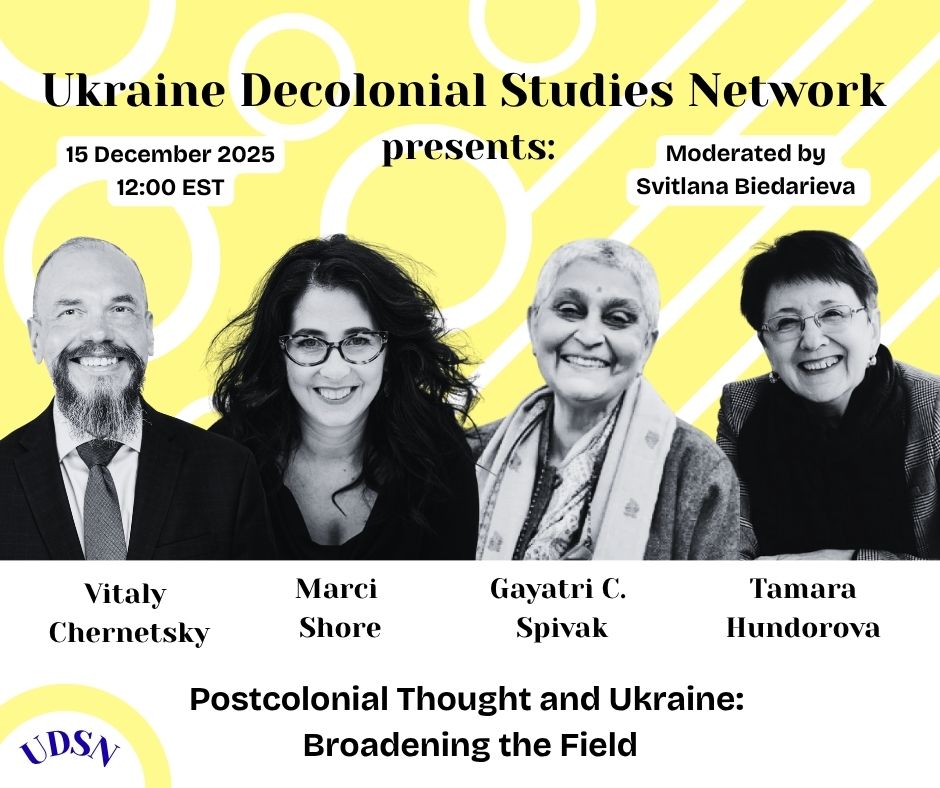
On December 15, 2025, Ukraine Decolonial Studies Network launched its 2026 Speaker Series with an inaugural panel discussion on Ukraine’s shifting place within global postcolonial and decolonial frameworks. The event brought together renowned scholars and thinkers — Gayatri Chakravorty Spivak, Marci Shore, Vitaly Chernetsky, and Tamara Hundorova — for a thought-provoking conversation on the evolving trajectory of Ukrainian cultural studies within decolonial theory.
The panel, moderated by Svitlana Biedarieva, offered a rich and timely exchange on the intellectual and political challenges of engaging with Ukraine through a decolonial lens. The discussion highlighted key themes likely to shape future research in the field and fostered a sense of scholarly community and connection.
The event was supported by members of the Network’s board: Olha Korniienko, Oksana Nesterenko, Kateryna Yeremieieva, Sandra Joy Russell, and John Vsetecka.
This timely conversation reflected broader epistemic shifts in global knowledge production and underscored Ukraine’s growing significance in postcolonial discourse.
📺 Watch the full video recording
Ukraine Decolonial Studies Network at ASEEES 2025.
At ASEEES 2025, the Ukraine Decolonial Studies Network marked one year of affiliation with ASEEES by hosting two panels in the series “Contested Memory and Resistance to Neocolonialism in Ukraine’s Culture” and a roundtable on Ambicoloniality and War, the new book by UDSN founder Svitlana Biedarieva. The UDSN Affiliate Group Meeting brought together members to discuss ongoing projects and future plans, followed by a lively reception supported by Razom for Ukraine. Highlights.
Ukraine Decolonial Studies Network Recommends:
Podcast: The Ukraine Shelf
Presented by Olesya Khromeychuk and Uilleam Blacker. This podcast features conversations with leading authors, scholars, and journalists about what we should be reading to understand Ukraine’s politics, culture, and place in the world. Produced by the UCL Institute for European Studies in collaboration with the Ukrainian Institute London and UCL SSEES, with support from the British Academy. Listen to The Ukraine Shelf
New publication: Digital Warfare: Media and Technologies in the Russo-Ukrainian War
Edited by Nadia Zasanska and Nadiya Ivanenko | Bielefeld: transcript Verlag, 2025
This open-access volume examines how digital technologies—from AI and drones to memes and disinformation—shape the reality of Russia’s war against Ukraine. Contributors explore the role of virtual frontlines, the agency of individuals and communities in resisting aggression online, and how digital media empower Ukrainian resilience and democratic values. The collection includes case studies on diaspora engagement, neologisms in Western media, the spread of Russian propaganda, artistic responses, and Orthodox media narratives. More information.
New edited volume: The Holodomor in Global Perspective: How the Famine in Ukraine Shaped the World
Edited by Daria Mattingly and John Vsetecka. Foreword by Anne Applebaum. Ibidem Press, 2026.
This groundbreaking collection examines the 1932–33 Holodomor through a global lens, exploring how the famine in Soviet Ukraine resonated internationally. Moving beyond national narratives, the volume brings together multidisciplinary perspectives on how global politics, economics, and media engaged with the Ukrainian famine. It features contributions from leading scholars, including Olga Andriewsky, Ola Hnatiuk, Andriy Kohut, Serhy Yekelchyk, and others. More information.
New edited volume: Wartime Changes in Language Patterns of Ukrainians in Ukraine and Abroad
Edited by Volodymyr Kulyk and Laada Bilaniuk. Slavonic and East European Journal, Vol. 19, Nos. 3–4 (2025).
This special issue explores how Russia’s war against Ukraine has transformed language use and ideologies among Ukrainians at home and abroad. Moving beyond domestic language politics, the volume offers interdisciplinary insights into sociolinguistic change in the context of war, displacement, and migration. Contributions examine youth language practices, language in pedagogy, shifts among vloggers, online discourse, and refugee experiences in Germany. More information
New publication: Teaching Eastern Europe in the Age of Russia’s Imperial Invasions: A Conversation On Being Postcolonial When No One Takes Any Notice
By Oksana Dudko and Anna Hájková | History Workshop Journal, Vol. 99, Spring 2025, 150–177.
This open-access forum brings together six historians reflecting on decolonising Eastern European history in the context of Russia’s imperial violence. It highlights the region’s marginalisation in global postcolonial discourse and calls for a rethink of how history is written and taught. Read here | Podcast
Opportunities / Calls
Conference calls
Between Perestroika and the War in Ukraine: Alternative Temporalities in Eastern European and Jewish Histories
University of Vienna, Austria | June 29–30, 2026
Proposal deadline: February 15, 2026
This two-day international conference, hosted by the Research Centre for the History of Transformations (RECET) at the University of Vienna, invites scholars to explore the period between Perestroika and the ongoing war in Ukraine as a distinct historical chapter in Eastern European and Jewish histories. It aims to bridge Soviet/post-Soviet history and Jewish studies to reassess dominant narratives of transition, migration, and cultural memory.
The conference will focus on topics including Jewish agency and subjectivity beyond emigration narratives, regional perspectives beyond major metropoles, intersections with migration studies, artistic and memorial practices, and comparative experiences with other minority communities. Organised in cooperation with multiple European institutions, the event seeks contributions that interrogate historical periodisation, memory politics, and the complexities of Jewish life in Eastern Europe after the fall of the Soviet Union.
Abstracts (max 500 words) and bios (max 300 words) should be submitted to jannis.panagiotidis@univie.ac.at by February 15, 2026. Travel and accommodation for accepted participants will be covered, subject to funding. More information
Call for Papers: (De)colonial Solidarities Symposium
University of Turku, Finland (Hybrid) | August 27–28, 2026
Application deadline: February 15, 2026
This interdisciplinary symposium explores the complexities of solidarity and allyship in the context of whiteness and colonialism. It invites contributions on both historical and contemporary case studies, theoretical reflections, and cultural or artistic engagements with (de)colonial solidarities. Scholars at all career stages are welcome to apply.
Abstracts (250–300 words) and short bios should be submitted to alice.baroni@utu.fi with the subject line “(De)colonial Solidarities Symposium”. More information.
Tartu Conference 2026: Global Flows and Frictions in Eastern Europe and Eurasia
Tartu, Estonia | June 10–12, 2026
Proposal deadline: January 25, 2026
The 10th Annual Tartu Conference on East European and Eurasian Studies invites proposals for individual papers, panels, and roundtables that explore the effects of (de-)globalisation across the region. Organised by CEURUS at the University of Tartu, the conference brings together scholars from history, political science, sociology, anthropology, economics, cultural studies, and related fields to examine how people, goods, ideas, technologies, and capital have moved across borders—past and present—and how these flows have shaped integration, inequality, resistance, and transformation.
The 2026 theme invites critical reflection on cultural transfers, regional solidarities, disinformation, environmental change, demographic shifts, and challenges to global and regional orders. Keynote speaker: Dace Dzenovska (University of Oxford), Principal Investigator of the ERC-funded Emptiness project.
Submissions are encouraged from both senior and junior researchers. Scholars affiliated with Ukrainian institutions are eligible for a fee waiver. The event will be held in person.
Submit a proposal | More information | Contact: tartuconference@ut.ee
Call for Papers: Unsettling Heritage and Memory Futures – Decolonial Trajectories Between Crisis and Possibility
University of Amsterdam, Netherlands | June 17–19, 2026
Application deadline: March 27, 2026
The Amsterdam School for Heritage, Memory and Material Culture (AHM) invites submissions for its international conference exploring decolonial approaches to heritage, memory, and material culture. The event seeks to critically examine the transformative power and limits of decolonial praxis amid resurgent nationalisms and neocolonial challenges. Scholars, practitioners, artists, and activists—especially from the Global South—are encouraged to apply.
Proposals (250-word abstracts) for papers, panels, or roundtables should be submitted by email to: ahmannualconference@gmail.com. More information.
Conference: Ukrainian Studies in Times of Global Transformations of the Humanities
University of Manitoba, Winnipeg, Canada | April 30 – May 2, 2025
The Prairie Conference brings together scholars to explore the place and future of Ukrainian Studies amid global shifts in the humanities. The event will examine intellectual, disciplinary, and institutional transformations shaping the field today. Contact: Dr. Oksana Dudko (University of Manitoba) – oksana.dudko@umanitoba.ca, Dr. Yuliya Yurchuk (Södertörn University) – yuliya.yurchuk@sh.se
Publication calls
Call for Abstracts: Nordicum–Mediterraneum Thematic Issue on Decoloniality
Online | Publication date: September 2026
Abstract deadline: January 10, 2026
The peer-reviewed journal Nordicum–Mediterraneum, edited by Prof. Giorgio Baruchello (University of Akureyri), invites contributions for a special issue dedicated to Decoloniality. Drawing on the Horizon Europe project EXPECT_Art (EXPloring and Educating Cultural literacy Through Art), this issue explores diverse perspectives on decolonial theory and research practices. Submissions are welcome from all disciplines and traditions, with particular interest in interdisciplinary and collaborative approaches. Both theoretical reflections and empirical studies applying decolonial thinking in fields such as education, law, media, the arts, and institutions are encouraged.
Abstracts (up to 500 words) should be submitted to Carsten Friberg at cafr@sdu.dk by January 10, 2026.
More information | EXPECT_Art
Jobs
Professor of Ukrainian Studies (W3)
European University Viadrina, Frankfurt (Oder), Germany
Application deadline: January 4, 2026
The Faculty of Cultural Studies at the European University Viadrina invites applications for a tenured W3 Professorship in Ukrainian Studies, to begin on October 1, 2026. The position encompasses Ukrainian studies (19th–21st centuries) across teaching, research, and public engagement in a transnational and global context. Candidates should demonstrate excellence in cultural, historical, political, or social scholarship with a focus on Ukraine—especially contemporary issues—and possess a strong international publication record, university-level teaching experience, and a successful track record in securing third-party funding.
Applicants must be capable of contributing to institutional leadership in interdisciplinary Ukrainian and Eastern European studies, with teaching primarily in English and some in German. Fluency in Ukrainian is expected; proficiency in other relevant languages (e.g. Russian, Polish) is welcome. German language skills at C1 level must be acquired within two years if not already held. More information.
Postdoctoral Research Scholar in Ukrainian Studies
Columbia University in the City of New York
Application deadline: January 5, 2026
The Harriman Institute seeks a Postdoctoral Research Scholar in Ukrainian Studies for a two-year appointment, starting July 1, 2026. Postdoctoral research scholars are expected to concentrate on their own research and writing, which should be focused on some aspect of contemporary Ukrainian life, politics, and/or international affairs; to teach a course of their own design in the spring semester of each of the two years; to give a public seminar/lecture on their research; and to be active participants in the Institute’s scholarly community and events. The Scholar is required to be in residence in the New York City area. This position is made possible by the support of the Petro Jacyk Ukrainian Studies Fund. Details
Visiting Professor in Ukrainian Studies
Columbia University in the City of New York
Application deadline: January 6, 2026
Columbia University invites applications for an appointment in Ukrainian studies to be filled at the rank of Visiting Assistant Professor, Visiting Associate Professor, or Visiting Professor in Ukrainian Studies for one year in the academic year 2026-2027. Rank commensurate with experience. History is the preferred area of research and teaching specialisation, but literary/cultural studies and other regions will also be considered. The successful candidate will be appointed to one of the Humanities or Social Science Departments in the Faculty of Arts and Sciences and will teach three courses throughout the academic year: a broad-interest lecture course for undergraduates, a seminar for upper-level undergraduates, and a seminar for graduate students. Additionally, the successful candidate will be expected to deliver one public lecture and participate in the University’s academic life, including serving as an affiliate of the Harriman Institute. Details
Associate Professor / Professor – John Yaremko Chair in Ukrainian History
University of Toronto, Department of History
Application deadline: January 28, 2026
The University of Toronto invites applications for a full-time tenure-stream position in Ukrainian History at the rank of Associate Professor or Professor, with an anticipated start date of July 1, 2026. The successful candidate will also be eligible for a renewable five-year term as the John Yaremko Chair of Ukrainian History.
Applicants should hold a PhD in History or a related field and have an established international research profile, with demonstrated excellence in research and teaching. Specialists of any era or area of Ukrainian history are encouraged to apply. The position requires scholarly leadership, a strong publication record, and an externally funded research program. Details.
Fellowships
KIU Research Fellowship in Interdisciplinary Ukrainian Studies
European University Viadrina (Frankfurt/Oder, Germany)
Fellowship dates: April 15 – July 15, 2026 (residential) / April – December 2026 (non-residential)
Application deadline: January 15, 2026
The KIU Research Fellowship supports innovative projects on Ukraine across disciplines including history, cultural studies, political science, law, STS, and related fields. For the summer term 2026, research should relate to the semester’s theme: “Nationalities, Minorities, and Identity: (Re)Configuring Ukraine?” Fellows will explore the historical and present roles of Ukraine’s diverse communities, addressing topics such as displacement, minority rights, cultural resistance, and shifting identities in the wake of Russia’s full-scale war. Both residential fellowships (on-site at KIU with a stipend of €2,000–2,300/month plus a travel allowance) and non-residential fellowships (for scholars based in Ukraine, with a stipend of €450/month) are available. Fellows are expected to actively participate in KIU’s academic life and present their research publicly. More information
Lesia Ukraїnka Visiting Fellowship
Institute for Human Sciences (IWM), Vienna
Fellowship period: 3 months between September 2026 and June 2027
Application deadline: January 16, 2026
The Lesia Ukraїnka Fellowship, part of IWM’s Ukraine and the World program, supports early-career scholars in the humanities and social sciences whose research addresses global issues in culture, society, or politics in relation to Ukraine. Projects engaging with feminism, literary history, anti-imperialism, or illness and disability—reflecting key aspects of Lesia Ukraїnka’s legacy—are especially welcome. Preference will be given to scholars currently based in Ukraine.
Fellows will join the vibrant scholarly community at the IWM in Vienna for a three-month term. The monthly stipend is €3,300 for postdoctoral scholars and €2,750 for PhD candidates. More information
Call for Applications: Ukraine Studies Fellowships
George Washington University – Petrach Program on Ukraine
Application deadline: February 28, 2026 (11:59 PM EST)
The Petrach Program on Ukraine at GWU’s Institute for European, Russian, and Eurasian Studies (IERES) invites applications for the 2026–2027 Ukraine Studies Fellowships. Open to scholars currently based in Ukraine or who were based there before February 24, 2022, the program offers three fellowship tracks: Non-resident Fellowship (12 months), Jnior Visiting Fellowship (12 months), Senior Visiting Fellowship (5 months).
These fellowships are supported by the Elliott School’s Fund for Scholars Affected by the War in Ukraine and offered in partnership with the Kyiv School of Economics and the Ukrainian Global University. More information and application
Call for Applications: Ukraine Studies Fellowships
Petro Jacyk Post-Doctoral Fellowship in Ukrainian Politics, Culture, and Society, 2026-2027
Application deadline: February 16, 2026.
The Petro Jacyk Program for the Study of Ukraine at the Centre for European and Eurasian Studies (CEES), Munk School of Global Affairs and Public Policy, University of Toronto is accepting applications for the Petro Jacyk Post-Doctoral Fellowship in Ukrainian Politics, Culture, and Society for the 2026-2027 academic year. The objective of the Post-Doctoral Fellowship is to annually support one of the most promising junior scholars studying contemporary Ukraine, thereby advancing academic understanding of Ukrainian politics, culture, and society. The Fellowship is made possible through the generous support of the Petro Jacyk Education Foundation. More information.
November-December 2025
UDSN at Association for Slavic, East European, & Eurasian Studies (ASEEES) Annual Convention
Ukraine Decolonial Studies Network Affiliate Group Business Meeting
Thu, November 20, 7:30 to 8:45pm EST, Washington DC Hilton, Floor: T, Cardozo
Organized and moderated by Svitlana Biedarieva (Independent Scholar), Olha Korniienko (Leibniz Centre for Contemporary History Potsdam, Germany), Kateryna Yeremieieva (Ludwig-Maximilians-U Munich, Germany), Oksana Nesterenko (New York University), John Vsetecka (Nova Southeastern U), and Sandra Joy Russel (Mt Holyoke College)
The event will be followed by a drinks reception.
Please indicate your interest in attending the meeting and reception here: https://forms.gle/nbQL8HD3fCzvsK9o7
Contested Memory and Resistance to Neocolonialism in Ukraine’s Culture I
Panel series sponsored by Ukraine Decolonial Studies Network
Sun, November 23, 10:00 to 11:45 am EST, Floor: T, Columbia 6
Svitlana Biedarieva (Independent Scholar): Neocolonialism, Memory, and Cultural Resistance: Ukrainian Art under Attack
Masha Shpolberg (Bard College): Ukrainian Cinema Post-2022: Haunting Pasts and Insistent Presents
Kateryna Yeremieieva (Ludwig-Maximilians-U Munich, Germany): Decolonising Laughter: Ukrainian Bloggers’ Revision of Humour and Cultural Memory
Chair: Oksana Nesterenko (Union College); Discussant: Ksenia Turkova (Independent Scholar)
Contested Memory and Resistance to Neocolonialism in Ukraine’s Culture II
Panel series sponsored by Ukraine Decolonial Studies Network
Sun, November 23, 12:00 to 1:45pm EST, Floor: T, Columbia 6
Olha Korniienko (Leibniz Centre for Contemporary History Potsdam, Germany): Fashion as Resistance: Ukrainian Identity from Late Socialism to Wartime
Sandra Joy Russell (Mt Holyoke College): Intimate Resistance: The Kharkiv School of Photography and the Politics of the Body in Late Soviet Ukraine, 1971-1991
Lia Dostlieva (Independent Artist): Art as a Decolonial Tool: Family (Her)stories in the Practice of Contemporary Female Artists
Chair: Mariia Shynkarenko (Institute for Human Sciences, Austria); Discussant: Yuliya Yurchuk (Södertörn U, Sweden)
Other events by our executive board, members, and those relevant to our research focus, can be found in our comprehensive ASEEES Digest 2025:
https://ukraine-decolonial.org/wp-content/uploads/2025/07/aseees_2025_udsn-.pdf
NEW: Ukraine Decolonial Studies Network Event Series
Postcolonial Thought and Ukraine: Broadening the Field
December 15, 2025 | 19:00–20:30 CET | Online
The inaugural panel of our new event series explores the role and limitations of postcolonial knowledge in the contemporary world, examining the transformations it has undergone in the context of Russia’s war in Ukraine. Bringing together interdisciplinary voices of international and Ukrainian scholars, it investigates the tensions and possibilities that arise in the changing field of postcolonial studies with its expansion and inclusion of previously invisible and marginalized communities and territories, as well as new methods, themes, and concerns. The speakers explore how language and culture mediate knowledge production across old colonial divides, and what happens when once-dominant epistemologies violently confront formerly subaltern societies in a postcolonial world.
Speakers: Gayatri Chakravorty Spivak (Columbia University), Marci Shore (University of Toronto), Tamara Hundorova (NAS of Ukraine / Wissenschaftskolleg zu Berlin), Vitaly Chernetsky (University of Kansas)
Moderator: Svitlana Biedarieva (UDSN)
Organized by the Ukraine Decolonial Studies Network (UDSN), the event will bring together leading scholars to examine the tensions and possibilities in expanding postcolonial studies to include Ukraine’s experience and voice. Register for the event.
Ukraine Decolonial Studies Network Recommends: Future Events
Café Kyiv 2026
Berlin, February 23, 2026
Application deadline: November 21, 2025
Café Kyiv invites proposals for its fourth edition—an interdisciplinary public event focused on Ukraine, combining politics, academia, culture, and networking. This year’s edition will again feature the Skrynya pop-up market, film screenings, exhibitions, concerts, and discussions centered on the themes of freedom, security, and reconstruction.
Submit your program idea via the application form: Apply here
More information: Café Kyiv Website
Publications & Media
New edited volume: Images and Objects of Russia’s War against Ukraine. Edited by Natasha Klimenko, Miglė Bareikytė, and Viktoryia Sereda. Transcript / Columbia University Press, 2025.
This interdisciplinary collection explores how Russia’s full-scale war against Ukraine is represented, interpreted, and contested through visual and material culture. Drawing on media studies, anthropology, and memory studies, the volume investigates the role of images and objects in shaping public understanding, political narratives, and cultural memory of the war.
More information | Book presentation: 13 Jan 2026
New publication: Культурна колонізація. Страх, приниження та опір України в радянській імперії (Cultural Colonization: Fear, Humiliation, and Ukraine’s Resistance in the Soviet Empire)
Author: Radomyr Mokryk | Lviv: Local History Publishing, 2025
This book explores how the Russian‑Soviet imperial regime used cultural strategies to impose a sense of inferiority, distort Ukrainian history, and extend its power. At the same time, the author traces the resistance of the 1960s generation, dissidents and human rights activists who understood that defending Ukrainian identity under Soviet rule meant fighting for the future. The text underscores how these imperial legacies continue to shape Ukrainian society today.
Opportunities / Calls
Conference calls
30th Annual World Convention of the Association for the Study of Nationalities (ASN)
Columbia University, NY / 28-30 May 2026
Application deadline: November 19, 2025
The ASN World Convention, the largest international and inter-disciplinary scholarly gathering of its kind, welcomes proposals on
a wide range of topics related to nationalism, ethnicity, ethnic conflict and national identity in regional sections on the Balkans, Central Europe, Russia, Ukraine, Eurasia, the Caucasus, and Turkey/Greece, as well as thematic sections on Nationalism Studies and Migration/Diasporas. Disciplines represented include political science, history, anthropology, sociology, international
studies, security studies, geopolitics, area studies, economics, geography, sociolinguistics, literature, psychology, and related fields. Conference website
CAPS 2026 Conference: Postcolonial Freedom(s)
Montreal, Canada (Hybrid) | June 4–6, 2026
Proposal deadline: December 31, 2025
The Canadian Association for Postcolonial Studies (CAPS) invites proposals for its 2026 annual conference on the theme Postcolonial Freedom(s). The event will be held in a hybrid format, welcoming both in-person and online presentations. Amid global challenges—ranging from war and climate catastrophe to AI and authoritarianism—the conference will explore evolving meanings and expressions of freedom in postcolonial contexts. Topics may include sovereignty, political agency, movement, ecological justice, aesthetic strategies, pedagogy, and more. Submissions are welcome in various formats: academic papers, panels, roundtables, workshops, performances, and digital or experimental contributions. Graduate students may apply for the Graduate Student Presentation Prize.
Submit a proposal | More information | Contact: caps2026conference@gmail.com
CEECON26: (Un)Certainties
Freie Universität Berlin, Germany | October 8–9, 2026
Application deadline: January 15, 2026
The third Congress of Central and East European Studies (ceecon26), organized by the German Association for East European Studies (DGO), Freie Universität Berlin, and ZOiS, invites proposals for papers, panels, roundtables, and PhD research presentations. Under the theme of (Un)Certainties, the conference will explore shifting power dynamics, historical and contemporary crises, memory politics, war, environmental change, migration, and contested global orders across Eastern Europe, the South Caucasus, and Central Asia. Scholars from all disciplines are welcome. No conference fee; travel grants are available for junior researchers without institutional support. More information | Submit proposals
10th Annual Tartu Conference on East European and Eurasian Studies
University of Tartu, Estonia | June 10–12, 2026
Application deadline: January 25, 2026
Organised by CEURUS at the Johan Skytte Institute of Political Studies, the 10th Annual Tartu Conference invites proposals for papers, panels, and roundtables on the theme Global Flows and Frictions in Eastern Europe and Eurasia. The event brings together scholars across disciplines—history, political science, sociology, anthropology, cultural studies, and beyond—to explore past and present dynamics of (de)globalisation in the region. Topics include cultural transfers, transnational solidarities, regional security, cyber vulnerabilities, brain drain, demographic decline, anti-globalist discourse, and re-regionalisation. Keynote speaker: Dace Dzenovska (University of Oxford). Scholars affiliated with Ukrainian institutions will have participation fees waived. The event is in-person only. Conference website
Publication calls
Call for Contributions: Post- und dekolonialistisches Denken in der Kritik
Edited volume by Monika Albrecht, University of Vechta (in German)
Application deadline: March 30, 2026
This forthcoming German-language handbook (under contract with de Gruyter) critically examines the theoretical foundations and contemporary uses of post- and decolonial thought. It aims to go beyond internal critiques by interrogating the epistemological assumptions and normative frameworks of post/decolonial studies. Contributions are sought on topics including discursive resignification, Indigenous knowledge, literary studies, and affect theory in post/decolonial contexts. Abstracts (ca. 500 words) and short CVs with relevant publications should be sent to monika.albrecht@uni-vechta.de. More information (in German)
Jobs
Visiting Professor in Ukrainian Studies
Columbia University in the City of New York
Application deadline: January 6, 2026
Columbia University invites applications for an appointment in Ukrainian studies to be filled at the rank of Visiting Assistant Professor, Visiting Associate Professor, or Visiting Professor in Ukrainian Studies for one year in the academic year 2026-2027. Rank commensurate with experience. History is the preferred area of research and teaching specialization, but literary/cultural studies and other regions will also be considered. The successful candidate will be appointed in one of the Humanities or Social Science Departments in the Faculty of Arts and Sciences and will teach three courses throughout the academic year: a lecture course of broad interest for undergraduates, a seminar for upper-level undergraduates, and a seminar for graduate students. Additionally, the successful candidate will be expected to deliver one public lecture and participate in the academic life of the University, including serving as an affiliate of the Harriman Institute. Details
Grants
HREC Research Grants Competition 2025–2026
Holodomor Research and Education Consortium, University of Alberta
Application deadline: November 17, 2025
The Holodomor Research and Education Consortium (HREC) invites applications for its annual research grants competition. The program supports original academic work that advances understanding of the Holodomor, including research, publication, preservation efforts, and participation in scholarly events. Grants typically range from CAD $1,500 to $3,500, with a maximum of $7,500 for individuals. Collaborative projects involving scholars in and outside Ukraine are also welcome. This year, successful applicants will be paired with research advisors and invited to submit their findings for publication. The initiative is supported by Global Affairs Canada as part of a broader effort to strengthen the National Museum of the Holodomor-Genocide. More information | Apply here
Fellowships
German-Ukrainian Fellowship for Humanities and Social Sciences Scholars
Max Weber Foundation / Bavarian Academy of Sciences | 2025–2026
Application deadline: November 25, 2025
The German-Ukrainian Fellowship Programme supports doctoral and postdoctoral researchers in the humanities and social sciences whose work focuses on East-Central Europe and/or German-Ukrainian history. Fellows may conduct archival or library research and/or focus on advancing a manuscript for up to six months, either in Ukraine (preferably at the Research Centre Ukraine in Lviv) or in Germany (preferably in Munich). Monthly stipends are €1,920 (PhD candidates) or €2,760 (postdocs), with additional child allowances. The programme emphasises bilateral academic exchange and provides support with travel and logistics.
More information | Contact: admissions@mws-ukraine.org
Postdoctoral Research Scholar in Ukrainian Studies
Columbia University in the City of New York
Application deadline: January 5, 2026
The Harriman Institute seeks a Postdoctoral Research Scholar in Ukrainian Studies for a two-year appointment, starting July 1, 2026. Postdoctoral research scholars are expected to concentrate on their own research and writing, which should be focused on some aspect of contemporary Ukrainian life, politics, and/or international affairs; to teach a course of their own design in the spring semester of each of the two years; to give a public seminar/lecture on their research; and to be active participants in the Institute’s scholarly community and events. The Scholar is required to be in residence in the New York City area. This position is made possible by generous support of the Petro Jacyk Ukrainian Studies Fund.
Members’ News
Congratulations to our members for their new achievements!
Kateryna Yeremieieva has been selected for a URIS (Ukrainian Research in Switzerland) fellowship at the Department of History, University of Basel, for the period from January 1 to June 30, 2026.
John Vsetecka edited, together with Daria Mattingly, a collected volume of essays The Holodomor in Global Perspective: How the Famine in Ukraine Shaped the World (ibidem Press).
Oksana Nesterenko was awarded a summer stipend from the National Endowment for the Humanities and a project development grant from the American Council of Learned Societies to support the research and writing of her forthcoming book A Forbidden Fruit? Sacred Music in the USSR Before its Fall.
Svitlana Biedarieva has received the Mary Zirin Prize for Independent Scholars, awarded by the Association of Women in Slavic Studies (AWSS).
August-October 2025
Ukraine Decolonial Studies Network Recommends: Upcoming Events
International Conference: Empires: Experience, Memory and Idea
October 1–3, 2025 | Pamplona, Spain
This interdisciplinary conference examines the historical and contemporary aspects of empires, concentrating on their lived experiences, cultural legacies, and ideological frameworks. Against the backdrop of resurgent great-power politics, the event brings together scholars to examine how empires—past and present—shape global inequalities, collective memory, and international relations. Key themes include imperial governance, resistance, cultural politics, and the contested role of empire in shaping identities. Special attention will be given to memory politics, symbolic debates, and the persistence of imperial thought in current global dynamics.
(Un)Safe Plurality: Ukraine and Beyond
UNDIPUS Network / Institute for East European Studies, Freie Universität Berlin | September 30 – October 2, 2025
This conference examines the role of Ukrainian studies and area research during wartime, exploring plural perspectives across literary, cultural, and social research. Key themes include post-/decolonial, gender, queer, language, memory, border, and ecocritical studies, with attention to the ethical and societal implications of knowledge production in times of conflict.
Program TBA
Publications & Media
New edited volume: Ukraine as a Migration Nexus: Perspectives on Historical and Current Population Movements. Edited by Oleksii Chebotarov and Viktoriya Sereda. Central European University Press, 2025.
This open-access collection examines Ukraine’s role as a pivotal site of migration and mobility, both past and present. It brings together case studies on internal and transnational movements, displacement, and identity formation, challenging traditional frameworks in migration research and centring Ukraine in broader global debates. More information
Podcast: Postcolonial Past and Present of Ukraine: Discussion in Kharkiv
Radio Nakypilo | July 16, 2025
Watch on YouTube
Ukrainian scholars at the intersection of history, identity, and culture discuss Ukraine’s postcolonial condition in this public forum. The event is part of the “City on the Line” platform, initiated in Kharkiv by historians, philosophers, sociologists, curators, writers, and media professionals. Speakers include: Masha Cerovich, historian, professor at EHESS, director of CERCEC (Paris); Daria Mattingly, historian and senior lecturer in European history, University of Chichester (UK); Bohdan Shumylovych, cultural historian and researcher at the Center for Urban History (Lviv).
New resource: Supporting Decolonisation in Museums: Focus on Ukraine
Published July 2025 | Ukrainian Institute, ICOM UK, Museums Association & partners
This new resource offers museum professionals practical tools to integrate Ukraine into global decolonisation efforts. Developed by Ukrainian and international experts, the guide challenges misrepresentation and colonial narratives, focusing especially on the legacies of the Russian Empire and the USSR. Read more & download the guide
Opportunities / Calls
Conference calls
Interdisciplinary Perspectives on Empire, Colonialism, and Anticolonialism
University of Cambridge, UK | October 17, 2025
Application deadline: August 30, 2025
This one-day, cross-disciplinary conference invites contributions from scholars at all career stages working on themes related to empire, colonialism, anticolonialism, and decolonisation. Hosted at the University of Cambridge, the event seeks to foster discussion across the arts, humanities, and social sciences. Relevant topics include historical and comparative accounts of colonialism, material resistance to empire, anticolonial theory and practice, the role of universities in colonial structures, and ongoing practices of colonisation and decolonisation. The event will conclude with a collaboratively written manifesto to be published on the Catalysts for Decolonisation webpage. Limited travel bursaries are available. More information
Shevchenko Workshop in Ukrainian Studies
October 31 – November 1, 2025 | Shevchenko Scientific Society, New York City
Application deadline: September 10, 2025
The Shevchenko Scientific Society (USA), in partnership with the American Association for Ukrainian Studies and Razom for Ukraine, invites applications from early-career scholars—PhD candidates at US universities and postdoctoral fellows within three years of degree—for an interdisciplinary workshop in Ukrainian Studies. Topics may include civil society, migration, memory, war, culture, gender, and other related areas. Participants will discuss pre-circulated papers, receive feedback from senior scholars, and may be eligible to receive travel grants covering airfare and lodging. Selected participants will also be prioritised for Razom’s travel grant to attend ASEEES 2026. Papers will be considered for publication in a special journal issue. More information
Bavarian-Ukrainian Workshop on Multilingualism
October 28–29, 2025 | University of Regensburg
Application deadline: August 31, 2025
The Bavarian Academic Center for Central, Eastern, and Southeastern Europe (BAYHOST), the Center for Interdisciplinary Ukrainian Studies “Denkraum Ukraine,” DAAD, and FoMuR will host a workshop on cooperation with Ukraine in the humanities, focusing on multilingualism. Building on last year’s conference, the 2025 workshop will explore language didactics, trauma processing, and strategies to strengthen academic collaboration with Ukraine. Lecturers and researchers from Bavaria, Ukraine, and beyond are invited to contribute presentations, workshops, or posters, and to exchange ideas and best practices. More information
BASEES 2026 Annual Conference
10-12 April 2026 | University of Birmingham
Application deadline: October 3, 2025
The British Association for Slavonic and East European Studies (BASEES) invites proposals for panels, roundtables, and papers for its 2026 annual conference. BASEES welcomes paper, panel, and roundtable proposals with an area-specific focus as well as positioned within disciplinary and interdisciplinary frameworks. These disciplines and areas include, but are not limited to: Politics; History; Sociology; Geography; Film and Media; Languages and Linguistics; Literatures and Cultures; Anthropology; Economics; Baltic Studies; Polish Studies; Ukrainian Studies. They particularly encourage proposals that help push forward efforts to decentre and decolonise the study of the region.
More information
Jobs
Postdoctoral Researcher – Ethnology or Gender Studies
University of Gothenburg, Sweden | Jan 2026 – Dec 2027
Application deadline: September 29, 2025
The Department of Cultural Sciences invites applications for a postdoctoral position in Ethnology or Gender Studies within the Horizon Europe project MAGnituDe, which examines migration and European democracy in the context of Russia’s invasion of Ukraine. The role involves full-time research, including fieldwork, participant observation, and interviews with displaced Ukrainians in Germany and Sweden, as well as producing publications. A relevant doctoral degree and experience in ethnographic or gender-focused research are required. More information
Grants
The Hvylya/Dalğa Prize
Ukrainian Institute | 2025 cycle
Nomination deadline: September 3, 2025
The Hvylya/Dalğa Prize recognizes individuals who have made significant contributions to promoting the Ukrainian and Crimean Tatar languages worldwide. The award honors outstanding achievements in spreading knowledge about these languages, enhancing their prestige, and expanding opportunities for their study. Eligible nominees include teachers, researchers, community leaders, writers, journalists, and others whose work has had a notable impact on the development and promotion of the Ukrainian and Crimean Tatar languages. More information
Endangered Archives Programme (EAP)
British Library | Round 21 Applications Open
Application deadline: September 12, 2025
The Endangered Archives Programme (EAP) supports the digitisation of archives worldwide that are at risk of destruction, neglect, or physical deterioration. Funded by Arcadia, a charitable foundation dedicated to preserving cultural heritage and promoting open access to knowledge, EAP has provided grants to over 500 projects across more than 90 countries, covering over 100 languages and scripts. More information.
Modern Endangered Archives Program (MEAP)
UCLA Library | 2025–2026 Cycle
Application deadline: November 17, 2025
The Modern Endangered Archives Program (MEAP) at UCLA Library supports the preservation and discovery of at-risk archival collections, promoting a more expansive understanding of modern cultural heritage. MEAP grants fund projects that document, digitize, and make accessible cultural heritage materials from the 20th and 21st centuries. The program prioritizes projects that reflect community voices, cultural expression, and historical experiences often excluded from national narratives and archives. The application portal opens on September 16, 2025: MEAP Online Portal.
Fellowships
Ukrainian Research Fellowship Programme (URFP) for Visiting Researchers
CBEES and Södertörn University, Sweden | Spring 2026
Application deadline: September 25, 2025
We are now welcoming applications for six scholarships for visiting Ukrainian researchers with a placement at CBEES or another department, centre, or unit at Södertörn University. This fellowship programme is tailored explicitly for lecturers and professors currently residing and working at higher education institutions or research institutes in Ukraine. While we deeply value the contributions of Ukrainian researchers abroad, this programme is designed to support those based in Ukraine. Applications are particularly encouraged from colleagues in the social sciences, humanities, teacher education, and environmental science. As the fellowship is closely aligned with Södertörn University’s research profiles, only applications within these fields will be considered.
More information
Fulbright: Ukraine Beyond Borders (All Disciplines)
One European country (outside Ukraine) | 2026 cycle
Application deadline: September 15, 2025
Applicants may propose projects focused on independent research, teaching, or teaching/research that engage with Ukraine and/or Ukrainian studies. Projects are invited from all disciplines, provided they emphasize Ukraine. Activities should engage colleagues in Ukraine remotely or directly involve displaced Ukrainian citizens beyond Ukraine’s borders. Grant activities must take place in one European country (outside Ukraine), and applications must clearly explain the choice of host country and its connection to Ukraine. Projects cannot be carried out in Ukraine, and visits to Ukraine are not permitted under this award. More information
The Academy Scholars Program
Harvard Academy for International and Area Studies, USA | 2026–2027 cycle
Application deadline: September 19, 2025
The Academy Scholars Program supports outstanding early-career researchers whose work combines social science excellence with in-depth expertise in regions and countries outside the United States or Canada. The program encourages innovative scholarship that bridges disciplinary boundaries and addresses comparative, transnational, or domestic issues, past or present. The Academy Scholars Program is dedicated to fostering emerging scholars whose research deepens global knowledge and advances critical perspectives on international and area studies. More information
Senior and Early Career Fellowship Programmes
Vienna Center for Advanced Studies (ViCAS) | 2026/27
Application deadline: September 1, 2025
ViCAS invites applications for its Early-Career and Senior Fellowships, running from October 1, 2026, to June 30, 2027. ViCAS is a new interdisciplinary centre at the University of Vienna dedicated to international collaboration, cutting-edge research, and dialogue across disciplines and generations. Early-Career Fellowships: For scholars who defended their PhD after September 1, 2017 (exceptions for career breaks). Benefits: €5,500/month stipend, €1,500/month housing allowance (+€500/month per child), workspace, and access to research libraries and networks. More information Senior Fellowships: For established international scholars with outstanding academic records. Benefits: €7,000/month stipend, €1,500/month housing allowance (+€500/month per child), workspace, and full participation in ViCAS’s intellectual life. More information
Ukrainian-American Arts Research Fellowship
Borshch of Art | September 29 – December 16, 2025
Application deadline: September 10, 2025 (5:59 pm ET)
A 12-week virtual fellowship for recent graduates, graduate, and pre-doctoral students researching Ukrainian and diasporic arts. Fellows develop a 15–20 page publishable paper with mentorship and present at Borshch of Art events. Apply with CV, 250-word proposal, and writing sample (1,500 words max). More information
Decolonial Infrastructure
Catalysts for Decolonisation (University of Cambridge)
This interdisciplinary lab brings together students, researchers, and community members to rethink the 20th century through the lens of anticolonialism and decolonial resistance. With a focus on empire, race, colonial memory, and global anti-imperial struggles, the group organises public events, cross-disciplinary academic discussions, and educational outreach. Their goal is to reframe dominant historical narratives and advocate for curricular change that centres colonial and anticolonial histories.
More: Catalysts for Decolonisation
Members’ News
Congratulations to our members for their new achievements!
Book Tour – Ambicoloniality and War: The Ukrainian-Russian Case
October 1–20, 2025
Svitlana Biedarieva will present her recent monograph Ambicoloniality and War: The Ukrainian-Russian Case across Europe, with events in Berlin, Stockholm, Utrecht, Amsterdam, London, Oxford, and Regensburg. Full tour schedule and details (forthcoming): svitlanabiedarieva.com
June-July 2025
Ukraine Decolonial Studies Network Recommends: Upcoming Events
ICCEES XI World Congress
21–25 July 2025 | University College London, Institute of Education
The XI World Congress of the International Council for Central and East European Studies (ICCEES) will be held at University College London, under the central theme of “Disruption.” The Congress will provide a platform for scholars to critically engage with the profound transformations shaping Central, Eastern, and South-East Europe, the Baltics, Russia, the Caucasus, and Central Asia. Emphasis will be placed on rethinking disciplinary approaches, reassessing methodological frameworks, and fostering interdisciplinary dialogue. In particular, the programme will include contributions that aim to decentre and decolonise the study of the region. More details | Program
Ukraine Decolonial Studies Network Recommends: Recent Events
Ukraine’s National Women’s League of America. Recording of “Decolonization of Ukrainian Studies” Panel Discussion: Watch here
The panel discussion features an international group of leading scholars to discuss the decolonization of Ukrainian studies and Ukraine’s ambassador to the U.S., Oksana Markarova. Panelists: Tetyana Filevska, Oleh Kotsyuba, Oksana Lutsyshyna, Grace Mahoney, Myroslav Shkandrij, Sophia Wilson, and Yuliya Yurchuk. Moderated by Eugenia Kuznetsova.
The 2025 Holberg Lecture, feat. Gayatri Chakravorty Spivak: “Imperatives to Re-imagine the Future”: Watch here
All our plans encounter the limit of the future anterior – the past in the future – a certainty that something “will already have happened” related to the plans we are launching. Today that “past,” in whatever future we can imagine, calls forth geological history, so that some of us think: “system change,” rather than “climate change,” is required. This lecture discusses how the humanities can elaborate that change.
Publications & Media
New issue: 𝙀𝙖𝙨𝙩/𝙒𝙚𝙨𝙩: 𝙅𝙤𝙪𝙧𝙣𝙖𝙡 𝙤𝙛 𝙐𝙠𝙧𝙖𝙞𝙣𝙞𝙖𝙣 𝙎𝙩𝙪𝙙𝙞𝙚𝙨 (𝘌𝘞𝘑𝘜𝘚). Vol. 10, No. 2. Published by the Canadian Institute of Ukrainian Studies. More information
New issue: Journal of Soviet and Post-Soviet Politics and Society. “Symbols and Narratives of Ukrainian Resistance.” Part I, 2024/2. More information
New edited volume: Svitlana Biedarieva, ed., Art in Ukraine between Identity Construction and Anti-Colonial Resistance, London: Routledge, 2024. More information
New edited volume: Kateryna Botanova, ed., Reclaiming History: Decoloniality and Art in Ukraine after 1991. Kyiv: PinchukArtCentre, 2025. More information
New edited volume: Decolonising Art: Beyond the Obvious. Kyiv: Ukrainian Institute, 2025. More information
New issue: Critical Forum: Empire and Decolonisation. Slavic Review, Vol. 83, No. 4 (Winter 2024). More information
Opportunities / Calls
Conference calls
19th Annual Danyliw Research Seminar on Contemporary Ukraine
University of Ottawa, Canada | September 25–27, 2025
Application deadline: June 26, 2025
The Danyliw Seminar is a leading annual forum for scholarly research on Ukraine. It brings together academics worldwide, including a strong contingent from Ukraine. The 2025 edition will take place in person in Ottawa and continues to prioritise the inclusion of scholars affected by the war.
The Seminar invites proposals from scholars (including PhD students) in the social sciences and humanities, policy analysts, journalists, and artists. Topics may address the current war or broader questions in Ukrainian studies, ranging from geopolitics, war crimes, and civil resistance to media, memory, and reconstruction. Selected participants will have their travel, accommodation, and visa expenses covered. More information
Think Space Ukraine Annual Conference: Organisations and Institutions in Times of War – Ukraine, Eastern Europe and Beyond
University of Regensburg, Germany | October 9–11, 2025
Application deadline: June 30, 2025
Organized by the Centre for Interdisciplinary Ukrainian Studies (Denkraum Ukraine), this conference explores how war transforms organisations, institutions, and everyday governance practices in Ukraine and across Eastern Europe. It invites papers from scholars working in history, sociology, political science, anthropology, law, and related fields. Contributions may address themes such as institutional continuity and collapse, legal adaptation, civil society under pressure, and the role of international organisations in wartime. Comparative and interdisciplinary approaches are welcome. More information
Bavarian-Ukrainian Workshop on Multilingualism
University of Regensburg, Germany | October 28–29, 2025
Application deadline: August 31, 2025
This two-day workshop, organised in cooperation with BAYHOST and FoMuR, focuses on multilingualism, language didactics, and trauma processing and emphasises academic cooperation with Ukraine. Researchers and lecturers from Bavaria, Ukraine, and other regions are invited to share experiences, present good-practice examples, and develop new project ideas. More information
11th CBEES Annual Conference – Knowing Eastern Europe and the Baltics
Södertörn University, Stockholm, Sweden | December 4–6, 2025
Application deadline: August 15, 2025 (23:59 CEST)
This interdisciplinary conference explores how knowledge about Eastern Europe and the Baltics is produced, contested, and situated in shifting geopolitical and epistemological landscapes. Scholars are invited to reflect on how uncertainty, denial, and rupture shape understanding through empirical, conceptual, or methodological lenses. Topics of interest include: decolonial epistemologies, centre–periphery dynamics, denial and ignorance, the allure of propaganda, AI and new technologies, quantitative and embodied knowledge, gender and positionality, and the impact of war and violence on knowledge production. Proposals for individual papers, panels, or roundtables are welcome from all disciplines. More information
Cultural Resistance: From Imperial Russia to Post-Soviet States
Amherst Center for Russian Culture, Amherst, Massachusetts, USA | March 28–29, 2026
Application deadline: September 1, 2025
This conference explores cultural resistance across Russian colonial and post-Soviet contexts—from imperial repression to contemporary authoritarianism. Scholars are invited to examine how cultural practices have historically challenged or subverted dominant power structures through literature, art, media, performance, and more. More information
Publication calls
Call for Submissions: Ukrainian Literature: A Journal of Translations (Vol. 7)
Deadline: September 1, 2025
Publication: Late 2025 or early 2026
The Shevchenko Scientific Society of Canada, under editor Maxim Tarnawsky, is now accepting original English translations of Ukrainian literary works for Volume 7 of Ukrainian Literature: A Journal of Translations. The journal appears in both print and online editions.
Submissions must be previously unpublished and preferably of works that have not been translated. Prose is especially encouraged; translations should include full texts or substantial portions rather than brief excerpts. Translators will be paid CAD $30 per page following publication. The journal acquires one-time-only print and online rights; translators retain all republication rights. If needed, the editor can assist with securing translation rights. Submissions should use minimal formatting and be sent in MS Word format. More information
Call for Editor
Canadian Slavonic Papers
Start date: 2026 or 2027
Deadline: August 15, 2025
The Canadian Association of Slavists invites expressions of interest for the position of Editor (or Co-Editors) of Canadian Slavonic Papers, the world’s top-ranked interdisciplinary Slavic studies journal. This is a unique opportunity for a scholar working in any area of Slavic studies to contribute to the field’s development through editorial leadership and mentorship. The role includes funding for an editorial assistant, administrative support, and potential course release or research compensation. Affiliation with a Canadian university is preferred but not required. For more information or to express interest, contact the current Editors, James Krapfl and Rolf Hellebust, at csp@ualberta.ca.
Jobs
Assistant Professor (Associate Senior Lecturer) Positions – Humanities & Theology
Lund University, Sweden
Application deadline: See official portal (rolling or upcoming)
Start date: February 1, 2026, or by agreement
Lund University invites applications for Assistant Professor (Associate Senior Lecturer) positions at the Joint Faculties of Humanities and Theology. These 4-year, research-focused positions offer a path to permanent employment as Senior Lecturer, with generous support and mentorship.
Candidates are invited to propose innovative research projects in one of the following areas: analytic philosophy or cognitive science; advanced 3D visualisation in archaeology; apocalyptic and post-apocalyptic studies; digital culture in times of crisis; global history of knowledge; or psycholinguistics, neurolinguistics, or language variation. Applicants must hold a PhD (preferably awarded within the last 7 years), demonstrate strong research potential, and have experience outside Sweden. Funding is available for staff, relocation support, and course release. More information and application instructions
Postdoctoral Researcher (Focus on Ukraine)
Central European University, Vienna, Austria
Application deadline: July 5, 2025
Start date: Fall 2025 (22-month position)
The Department of Sociology and Social Anthropology at CEU invites applications for a full-time postdoctoral position open to Ukrainian researchers. The postdoc will join the international research project “Times in Crisis, Times of Crisis: The Temporalities of Europe in Polycrisis” (HERA–CHANSE) and work under the supervision of Prof. Vlad Naumescu. The successful candidate will study how religion, ritual, theology, and/or law shape responses to war and crisis, focusing on Ukraine and the region. Fieldwork, publication, and collaboration with a European research consortium are central components of the position.
Requirements: PhD in anthropology or related field; expertise in religion, crisis, and Ukraine; fluency in English and Ukrainian. Salary: EUR 69,060/year (gross), plus research and travel funding. More information
Grants
SHERA Graduate Student / Independent Scholar Travel Grant – ASEEES 2025
Deadline: July 1, 2025
Conference: ASEEES Annual Convention, Washington, DC | November 20–23, 2025
The Society of Historians of Eastern European, Russian, and Eurasian Art and Architecture (SHERA) offers a travel grant of up to $1,000 to support one graduate student or independent scholar presenting a paper at the in-person ASEEES Convention. Applicants must be SHERA members and submit a single PDF including: paper title and 250-word abstract, brief CV (max 2 pages), panel title and chair name(s), and a short statement of financial need. Send applications to: shera.artarchitecture@gmail.com. Subject line: SHERA-ASEEES 2025 Travel Grant
Fellowships
IIE Scholar Rescue Fund (IIE-SRF)
Deadline: Rolling (submission by July 2025 recommended)
Duration: Up to 12 months (renewable)
Host: Institute of International Education (IIE), USA
The IIE Scholar Rescue Fund provides temporary academic positions for scholars at risk due to war, repression, or threats to academic freedom. Ukrainian researchers are eligible and encouraged to apply. The program offers fellowships of up to $25,000 USD, health insurance, relocation assistance, and professional development support. Host institutions typically contribute salary supplementation and research funding.
Eligible applicants must hold a PhD or equivalent, demonstrate academic excellence, and face serious threats or displacement. Applications are accepted on a rolling basis, with quarterly selection cycles. More information
KIU Research Fellowship in Interdisciplinary Ukrainian Studies
European University Viadrina, Germany | October–December 2025
Application deadline: June 25, 2025
This three-month residential fellowship supports interdisciplinary research on Ukraine under the theme “Infrastructural Fragmentation, Infrastructural Resilience.” Fellows will be based at European University Viadrina and collaborate with Berlin-based partner institutions. Open to scholars in history, political theory, sociology, anthropology, infrastructure studies, and the arts. Applicants must have completed their PhD by June 2023 and have at least two years of postdoctoral experience. The fellowship offers a monthly stipend (€2,000–2,300), a €600 travel allowance, workspace, housing support, and access to KIU programming. More information
Members’ News
Congratulations to our members for their new achievements!
Sandra Russell published a new article, “She’s Our Fathers’ Daughter”: Soviet Citizens and the ‘Free Angela Davis’ Movement—Re-imagining Communist Belonging Under Brezhnev” in American Communist History, May 30, 2025. Read more
Olha Korniienko has been awarded a Marie Skłodowska-Curie Actions (MSCA) for Ukraine Postdoctoral Fellowship for 18 months at the Leibniz Centre for Contemporary History in Potsdam, Germany. Her project is titled “Threads of Identity: Ukrainian Soviet Fashion from World War II to Independence.”
Svitlana Biedarieva published a new book Ambicoloniality and War: The Ukrainian–Russian Case in Palgrave Macmillan. Read more
If you have any information relevant to this newsletter, please send it to ukraine.decolonial@gmail.com. Also, stay tuned for our upcoming ASEEES Digest.

